
Classified as a “Phanerophyte (P)”. Its habitat is “Forests and shrublands (W)”. Cupressus sempervirens trees thrive in Mediterranean climates. They are found in rocky areas, plains, open forests, and coastal mountains.
(height, leaf arrangement, leaf shape, root system)
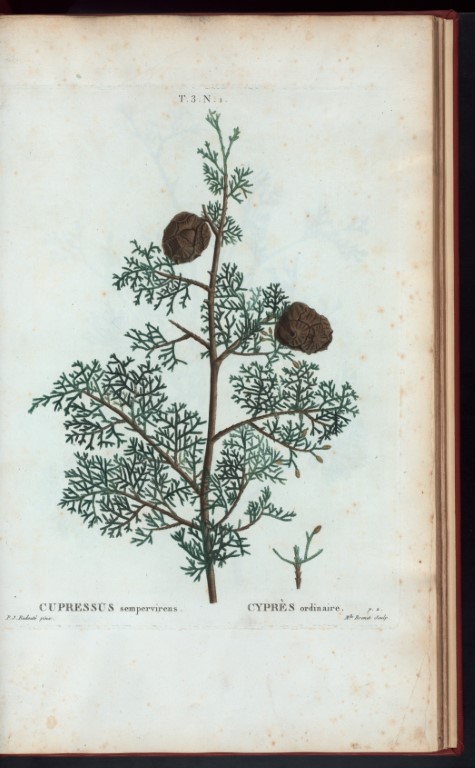
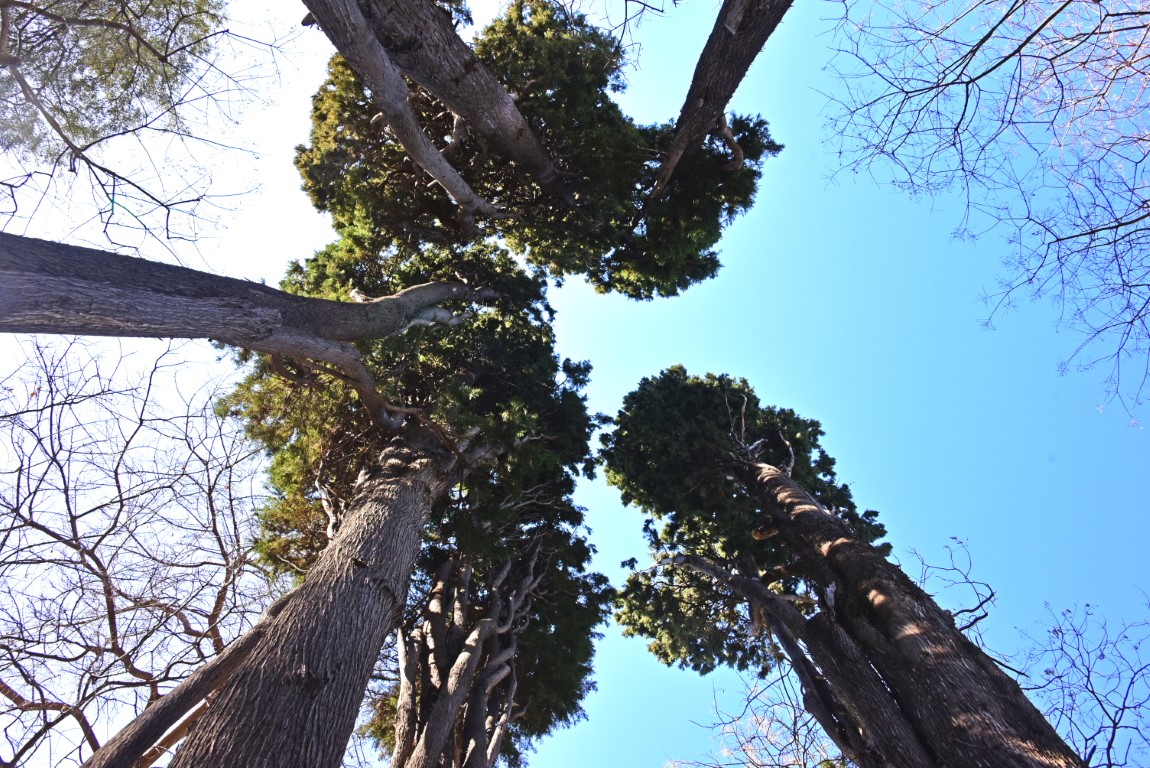
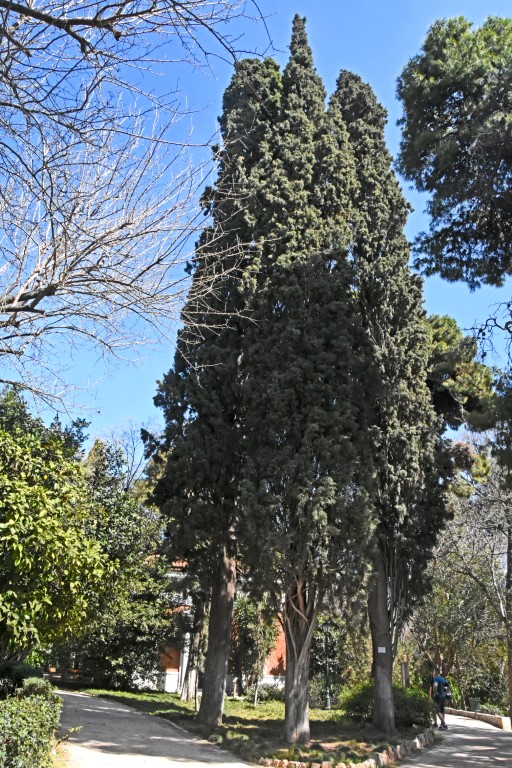
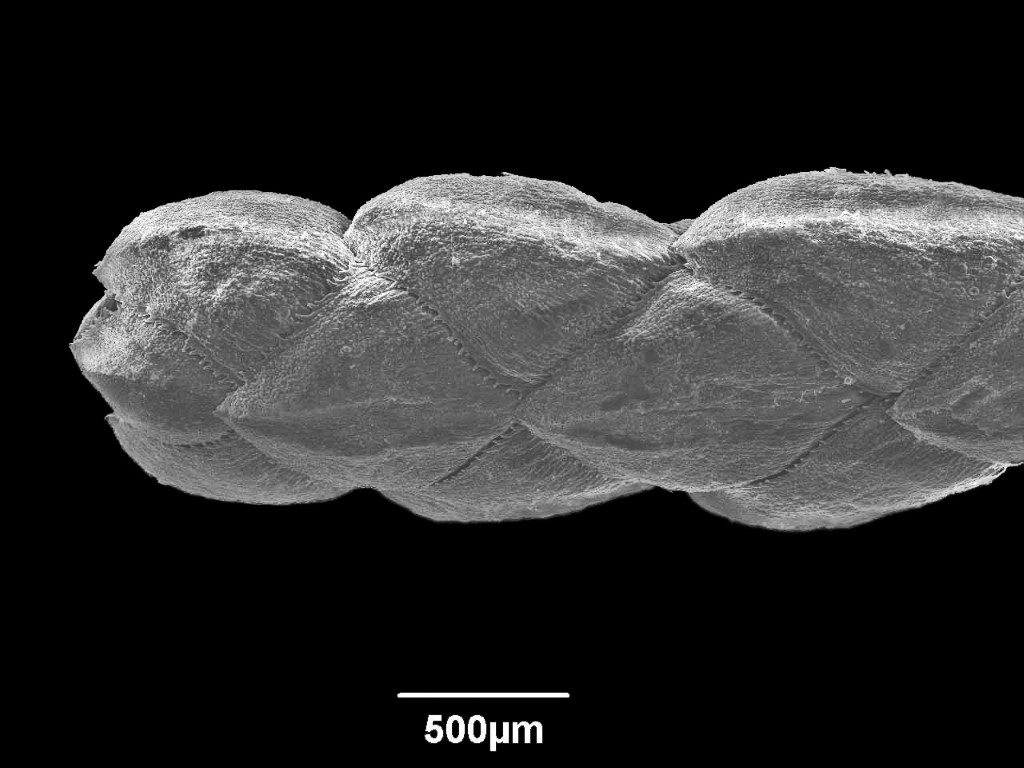
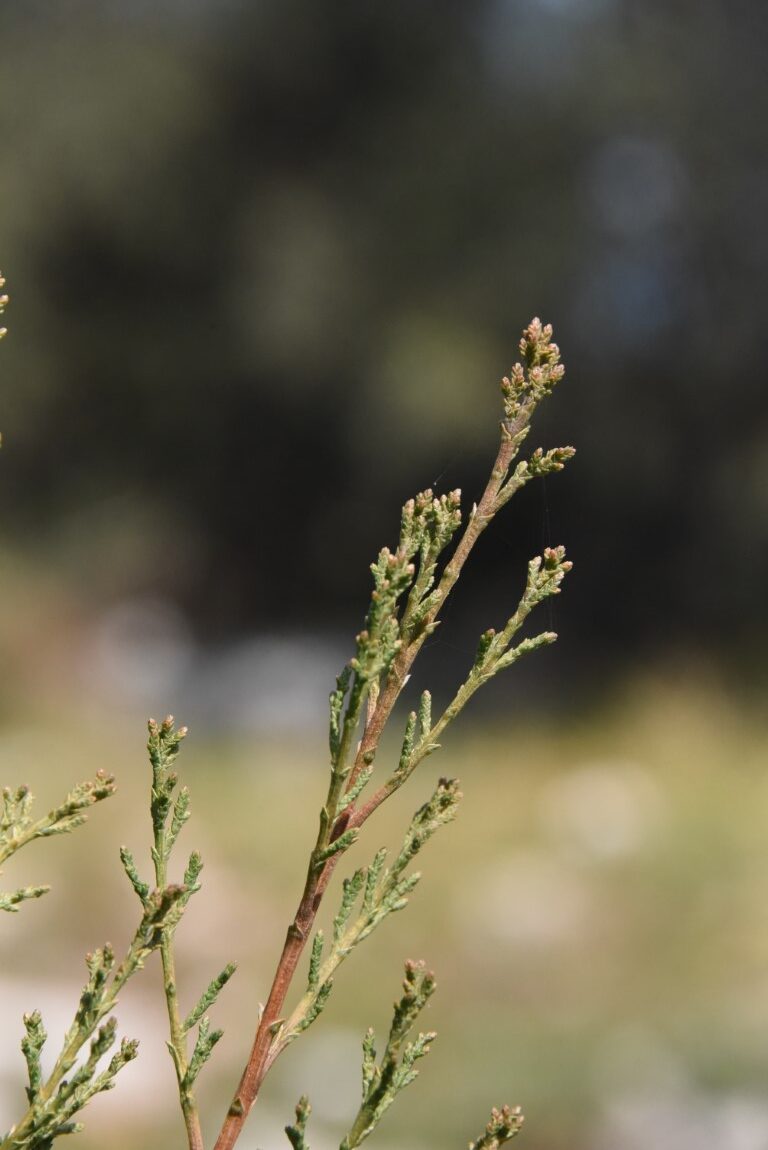
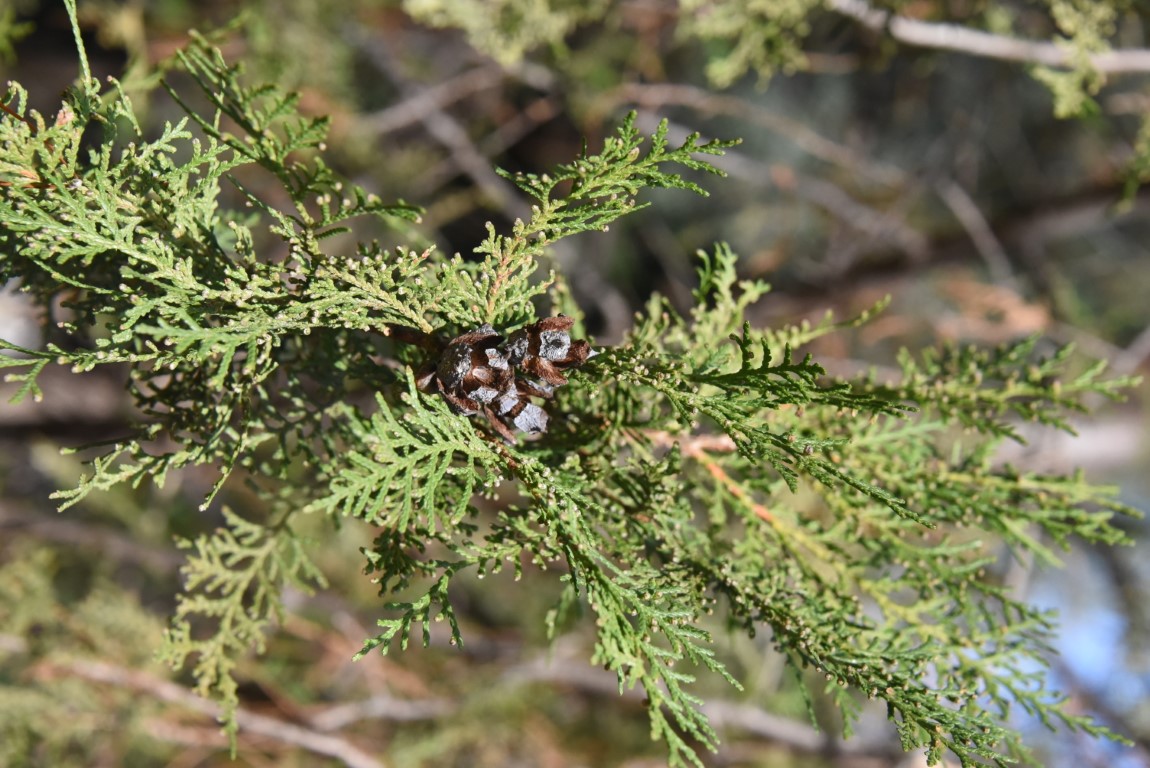
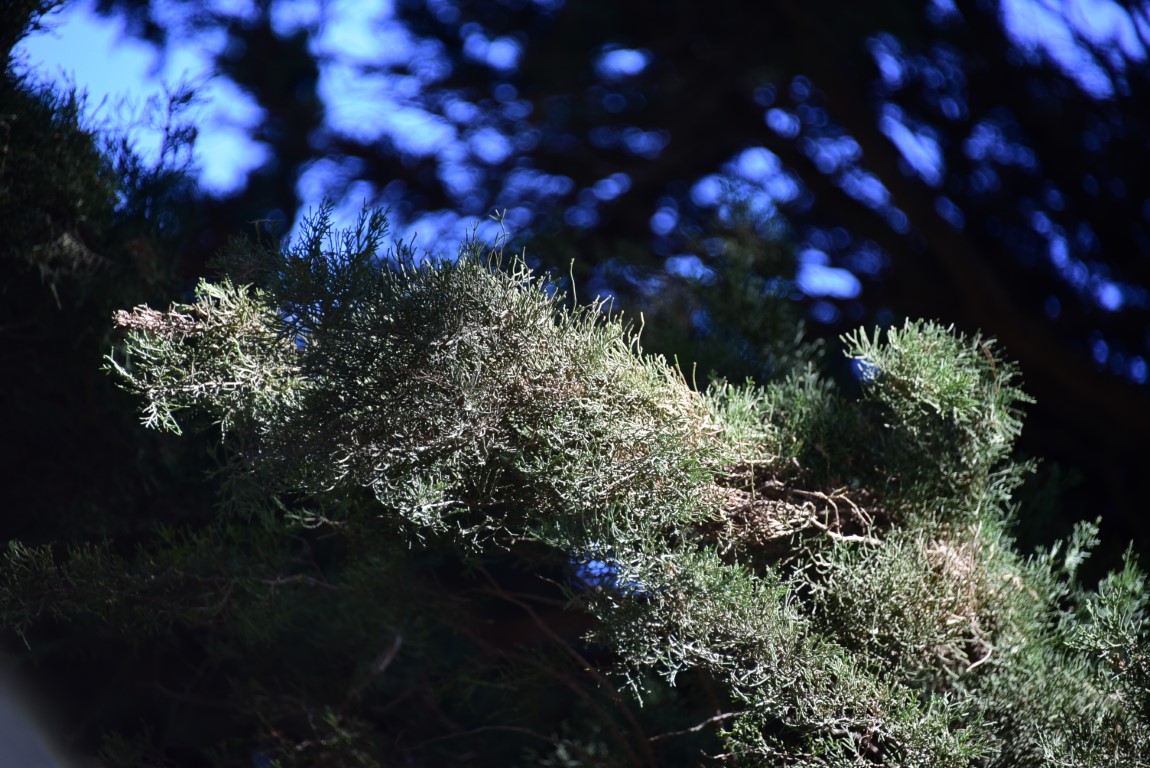
The height of the trees usually reaches 15–25 m, but under favorable conditions, it can exceed 30 m. The bark is smooth on young individuals but over time it acquires furrows that resemble strips of grey – red to greyish hue. The shoots are small, quadrangular, closely appressed to the central trunk, creating a very compact form. The leaves are small scales of dark green color arranged decussately (crosswise). The epithet “sempervirens” means “evergreen”, as the trees of the species retain their foliage.
(flowering period, flowers, seeds)
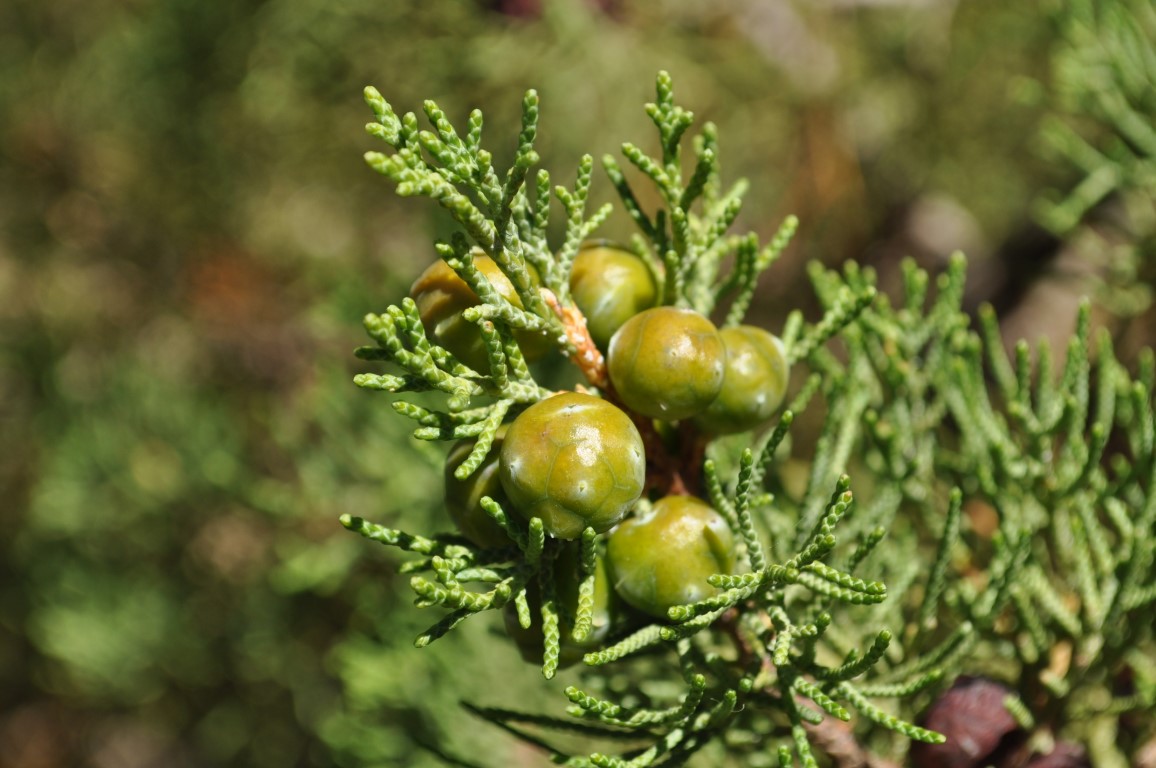
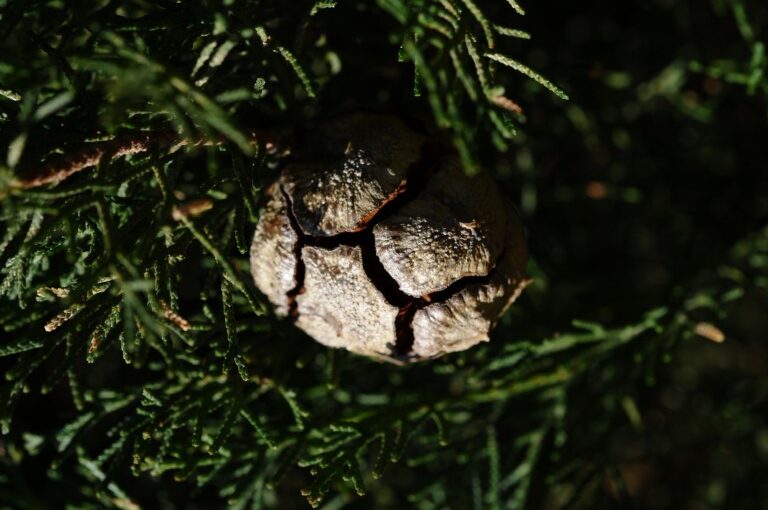
This monoecious species has both male and female flowers, though they’re not noticeable. Unlike typical flowers, these ones are composed of scales and bracts arranged around a central axis. The flowering period lasts from the beginning to the end of Spring. The male cones are small and cylindrical, 3–5 cm long and 2 mm in diameter and are found at the tips of the branches. From mid-Winter to early Spring, they are covered in pollen, which is subsequently dispersed to fertilize the female cones of the same or a neighboring tree. The female cones are larger and spherical, with a length of 2-4 cm and a diameter of 2-2.5 cm, while their maturation time is 2 years. Once fertilized, the cone develops a woody form that can persist for several years, until conditions are favorable for germination, like a high temperature following a forest fire.
It differs from the typical form of the species (Cupressus sempervirens var. horizontalis), which has a more open and spreading crown. The pyramidal crown is due to genetic selection, not environmental factors.
Cypresses in ancient Greece have been encountered since the time of Homer, who mentions that they covered the cave of Calypso in the Odyssey. Pausanias later observed many cypresses in the precinct of the sanctuary of Asclepius at Titane (Sicyon). Outside of Greece, Herodotus recounts that women in Scythia created a thick paste from cypress, cedar, and frankincense by pounding them on a rough stone and adding water. With this mixture, they anointed their bodies and faces.
Theophrastus describes the cypress as evergreen and notes its prickly leaves. He observes that in most areas the cypress grows from seeds, but in Crete, it also regenerates from the trunk. Specifically, if it is pruned or cut, it sprouts shoots in every possible way. He notes that it dislikes both manure and excessive water, and indeed, it is said to die if watered too much when young. In Crete, on the mountains of Ida and the White Mountains, the cypress is found on peaks where the snow never melts, while it is also encountered in Rhodes and Lycia. He adds that for conifers, the process known as “topping” is fatal, as they cease to develop if their young top is removed. Furthermore, its wood is resistant to rot. The cypress wood of Ephesus, from which the doors of the newer temple were made, had been stored for four generations, and it is the only wood that accepts such a fine polish.
Thucydides, in the “Pericles’s Funeral Oration”, points out that for the dead people of the first year of the Peloponnesian War, “In the funeral procession cypress coffins are borne in cars, one for each tribe; the bones of the deceased being placed in the coffin of their tribe. Among these is carried one empty bier decked for the missing, that is, for those whose bodies could not be recovered.” («λάρνακας κυπαρισσίνας ἄγουσιν ἅμαξα… μία δὲ κλίνη κενὴ φέρεται ἐστρωμένη τῶν ἀφανῶν»).
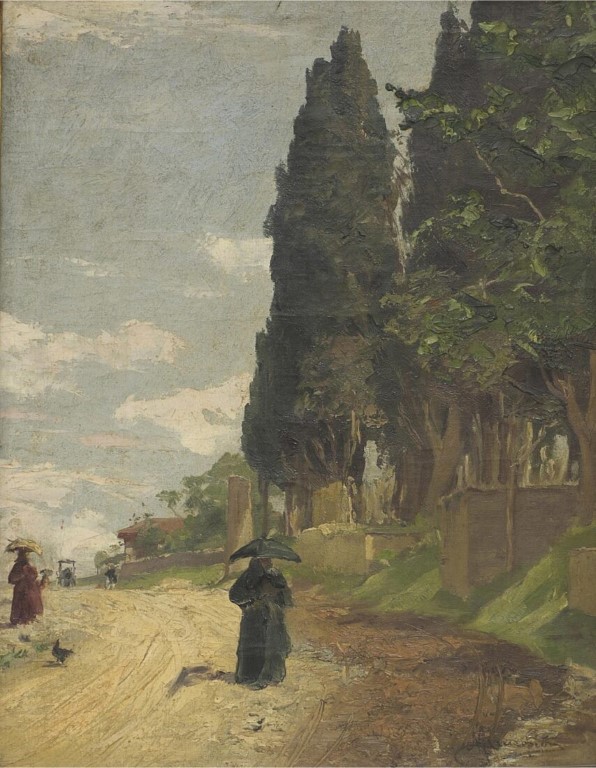
Ovid informs us of the myth of Cyparissus, a beautiful youth from Kea who was beloved by the god Apollo. He cared for a tame stag with affection, offering it food and water and decorating its horns with garlands. However, Cyparissus accidentally wounded the animal fatally with a javelin, an event that filled him with unbearable grief. In his despair, he begged to mourn his beloved friend’s loss forever. The god Phoebus, moved by his sorrow, transformed him into a cypress, a tall and slender tree with a conical top. Since then, the cypress has been considered a symbol of eternal mourning and memory of loved ones. The ancient Greeks, following the death of a loved one, hung cypress branches on their doors, decorated the bodies of the dead with them, or burned the funeral pyres upon them. The sap of this tree forms drops resembling tears on its trunk. In Greece today, the cypress appears to have a very wide distribution throughout the country, a fact attributed to the presence of planted cypresses in all cemeteries.
It is cultivated as an ornamental, in monuments, and symbolic plantings. The wood of the species is extremely durable and hard, while its scent repels moths, resulting in its wide use in furniture making. It is utilized in many cases for reforestation, as it can grow in areas with difficult climatic conditions and without an excess of nutrients in the soil.
(Note: Ethnobotanical data regarding the medicinal uses of plants must be handled with caution, and their application should be carried out exclusively under medical supervision).
- https://mymediterraneangarden.com
- https://www.moa.gov.cy
- https://www.metmuseum.org
- Dimopoulos P., Raus Th., Bergmeier E., Constantinidis Th., Iatrou G., Kokkini S., Strid A. & Tzanoudakis D. 2013: Vascular plants of Greece: An annotated checklist. – Berlin: Botanic Garden and Botanical Museum Berlin-Dahlem; Athens: Hellenic Botanical Society. – Englera 31. https://doi.org/10.3372/en.31
- Duhamel du Monceau, M. (1801). “Traité des arbres et arbustes qui se cultivent en France en pleine terre”. Paris: Chez Didot ainé, Michel, et Lamy.
- Heldreich, T. von. (1925). The common names of plants scientifically identified. Athens: Ioannis D. Kollaros, Estia Bookstore.
- Ovidius, “Metamorphōsēs”, 10.86
- Herodotus, “Histories“, Book IV, Melpomene, 75
- Theophrastus, “Enquiry into Plants“, 1.9.2, 1.10.3, 2.2.2, 2.7.1, 5.4.2, 5.7.4
- Thucydides, “History of the Peloponnesian War“, 2.34
- Homer, “Odyssey“, Book V, line 50
- Papageorgiou-Venetas, A. (2008). O kipos tis Amalias [Amalia’s garden]. Ikaros.
References in Αrt
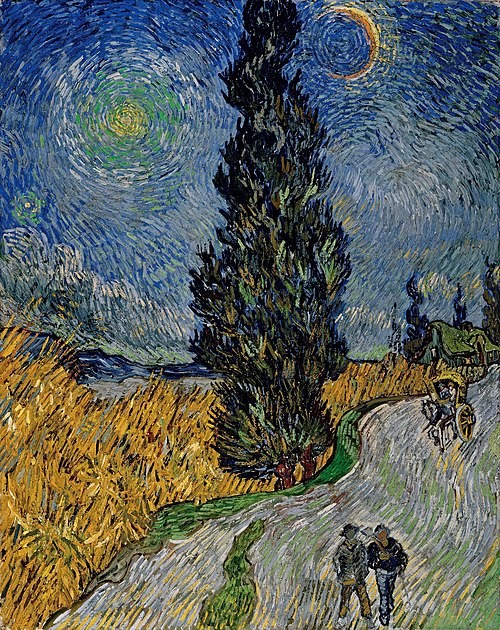
The most famous artistic references to this species are found in the works of Vincent van Gogh, specifically “The Starry Night”, “Wheat Field with Cypresses”, and “Cypresses”, where the cypress tree serves as a fundamental element of each painting. Cypresses also take center stage in numerous other paintings by renowned artists, primarily due to their symbolic significance regarding the transition from life to death. In Greek literature, notable examples include: Kostis Palamas: The poem “The Gentle Black Cypress” from the 1928 collection “Timid and Harsh Verses”. In this work, a female figure representing “beauty” must remain upright and proud—like a cypress—even when surrounded by the “ugliness” and pettiness of society. Loukis Akritas: In his short chronicle “The Cypress” (1939), he depicts a family’s bond with the cypress tree in their courtyard. They view it as the protector of their home, until its destruction by lightning symbolizes the end of an era and the loss of their roots. In music, Manos Hadjidakis won first prize at the 2nd Greek Song Festival in 1960 with the song “To Kyparissaki” (The Little Cypress), featuring his own lyrics and performed by Nana Mouskouri. Furthermore, the cypress is frequently encountered in traditional folk songs throughout Greece. Finally, the botanist Theodor von Heldreich noted in 1926 that the common name for the tree’s fruit is “kyparissomilo” (cypress-apple), a term regularly found in poetry and literature. Finally, inspired by the poetry of the Czech Gustav Pfleger Moravský, Antonín Dvořák composed his 1887 string quartet arrangement consisting of twelve miniatures, titled Cypresses (Echo of Songs).