

The Chinese fan palm thrives in well-drained and nutrient-rich soils. It prefers locations with sun or partial shade. Young individuals do not show resistance to cold, while more mature ones can survive under mild cold conditions (down to -6 °C). The species is usually cultivated in regions with a tropical or subtropical climate.
(height, leaf arrangement, leaf shape, root system)
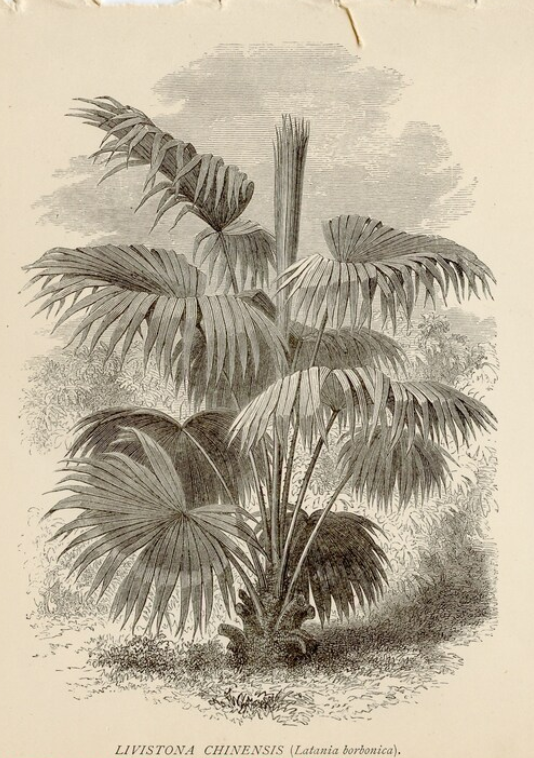
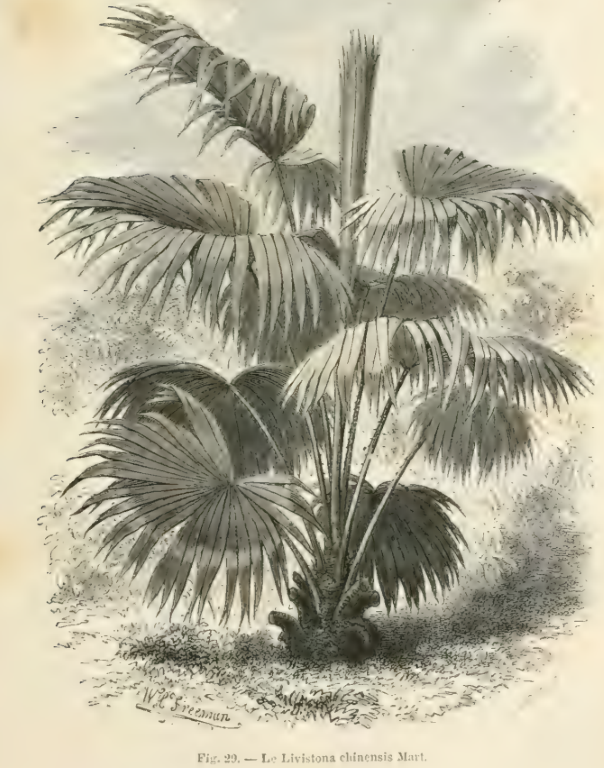
Evergreen palm of medium size with a height of 9–15 m and crown width up to 4.5 m. It has a soft light brown trunk, from which large and rough blue-green leaves that hang downwards sprout, creating the image of flowing water, a fact to which its common name “Fountain Palm” is owed. The trunk has obvious indentations from older leaves that have fallen. The leaves are petiolate (stalked), 120–180 cm long, palmate, with parallel venation. Each one is divided into 60–90 segments. The petiole can reach a length of up to 180 cm. Regarding the root system, a long central taproot develops, giving the plant the ability to survive during periods of drought.
(flowering period, flowers, seeds)
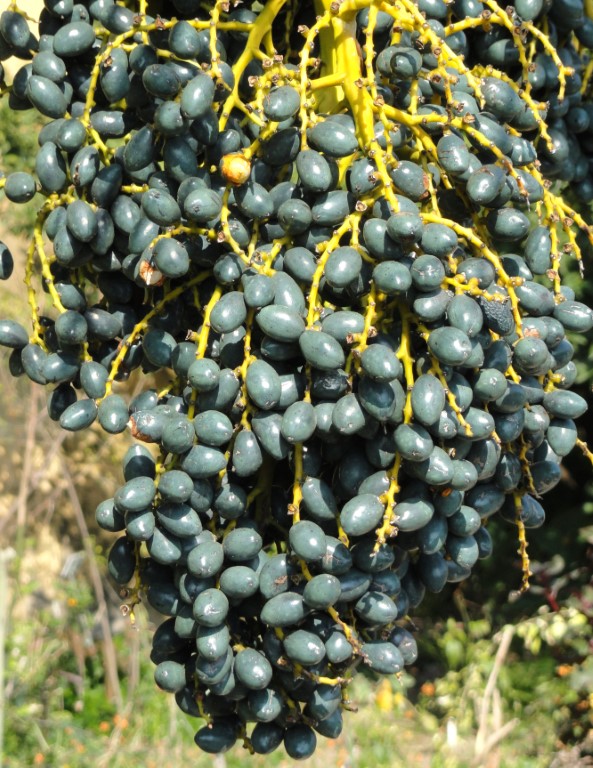
Monoecious species with separate female and male flowers, although there are records describing it as dioecious. The flowers are yellowish and organized in large inflorescences. The flowering period lasts from March to May. Blue-green oval fruits, classified as drupes, develop after fertilization. The seeds are elliptical to oval, approximately 14 mm long.
The trees of the species develop at a particularly slow rate, reaching a height of just 5 meters over a period of 100 years.
The first official description of the species was made in 1801 by the naturalist Jacquin, who however gave it the name Latania chinensis. In 1828 it was renamed Livistona chinensis by the German botanist and explorer Karl Friedrich von Martius, following an earlier suggestion by the botanist Robert Brown in 1810.
During the 18th and 19th centuries, the Chinese Fan Palm was exported from its countries of origin and cultivated widely. Livistona chinensis belongs to the family Arecaceae and originates from East Asia, with natural distribution in China, Taiwan, southern Japan, regions of Southeast Asia, Australia, and islands of the South China Sea. The genus Livistona is widely distributed in the tropical and subtropical zones of Asia and Oceania, with three species found in southern China. Due to its hardiness and intense ornamental value, the species has been introduced and cultivated extensively worldwide as a decorative plant in urban and peri-urban landscapes, a fact that has significantly expanded its geographical dispersal beyond its natural ecosystems.
In Okinawa, Japan, the Fountain Palm is planted in places considered sacred, resulting in the plant itself being treated as sacred. In the past, its leaves were used for making buckets to draw water from wells.
The species has mainly ornamental use today. However, it has a long and documented use in the traditional medicine of China and East Asia, with different parts of the plant being utilized for specific therapeutic purposes. The seeds constitute the most important medicinal part and are used traditionally as anticancer agents, particularly for nasopharyngeal cancer, leukemia, stomach and liver cancer, while modern studies confirm their antiproliferative, antiangiogenic, antimicrobial, and antioxidant properties. The fruits are also consumed as a plant ingredient in soups in traditional Chinese diet to support liver health and treat liver cancers. The leaves are used in herbal preparations for cardiovascular diseases, while the roots show strong cytotoxic activity against various cancer cell lines, reinforcing the overall ethnobotanical importance of the plant as a source of bioactive compounds. The leaves can also constitute raw material for making hats and fans. Beyond pharmaceutical uses, the residues of seeds and fruits are also utilized environmentally, such as in the production of biochar for pollutant absorption.
(Note: Ethnobotanical data regarding the medicinal uses of plants must be handled with caution, and their application should be carried out exclusively under medical supervision).
- https://oki-park.jp
- https://powo.science.kew.org
- https://www.mnhn.fr
- https://www.worldfloraonline.org
- Kerchove de Denterghem, O. (1878). Les palmiers: Histoire iconographique, géographie, paléontologie, botanique, description, culture, emploi, etc. J. Rothschild.
- Singh, K., Murti, Y., Sanduja, M., Sharma, A. K., Vibha, N., Bansal, S., Shukla, K. S., & Kulshreshtha, M. (2023). Botanical, phytochemical and pharmacological aspects of Livistona chinensis: A traditional Chinese plant. Pharmacological Research – Modern Chinese Medicine, 9, Article 100301. https://doi.org/10.1016/j.prmcm.2023.100301
- Thompson, R. (1859). The gardener’s assistant: A practical and scientific exposition of the art of gardening in all its branches (W. Watson, Ed.). The Gresham Publishing Co.
- Zeng, X., Qiu, Q., Jiang, C., Jing, Y., Qiu, G., & He, X. (2011a). Antioxidant flavanes from Livistona chinensis. Fitoterapia, 82(4), 609–614. https://doi.org/10.1016/j.fitote.2011.01.017
- Zeng, X., Wang, Y., Qiu, Q., Jiang, C., Jing, Y., Qiu, G., & He, X. (2011b). Bioactive phenolics from the fruits of Livistona chinensis. Fitoterapia, 83(1), 104–109. https://doi.org/10.1016/j.fitote.2011.09.020
- Zeng, X., Xiang, L., Li, C., Wang, Y., Qiu, G., Zhang, Z., & He, X. (2012). Cytotoxic ceramides and glycerides from the roots of Livistona chinensis. Fitoterapia, 83(3), 609–616. https://doi.org/10.1016/j.fitote.2012.01.008
During each season you will see:
SPRING
Leaves
Flowers
SUMMER
Leaves
Unripe fruits
AUTUMN
Leaves
Ripe fruits
WINTER
Leaves
References in Αrt
Livistona chinensis is praised in traditional songs of Okinawa, Japan.