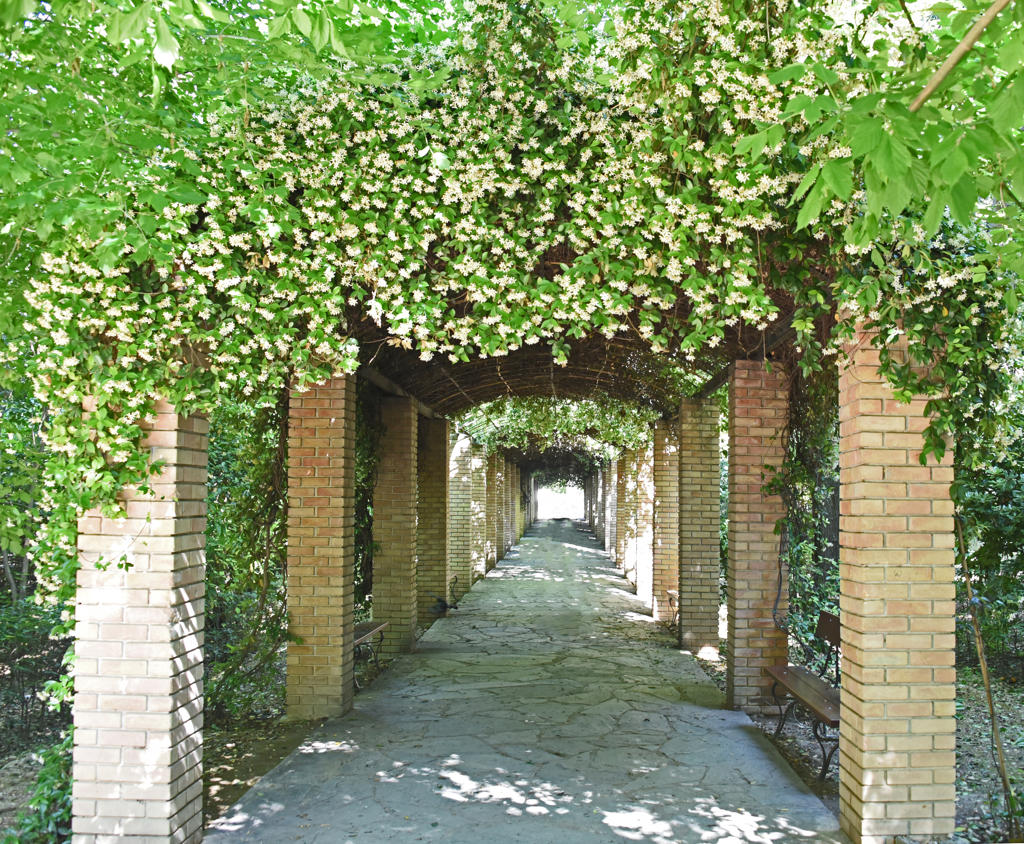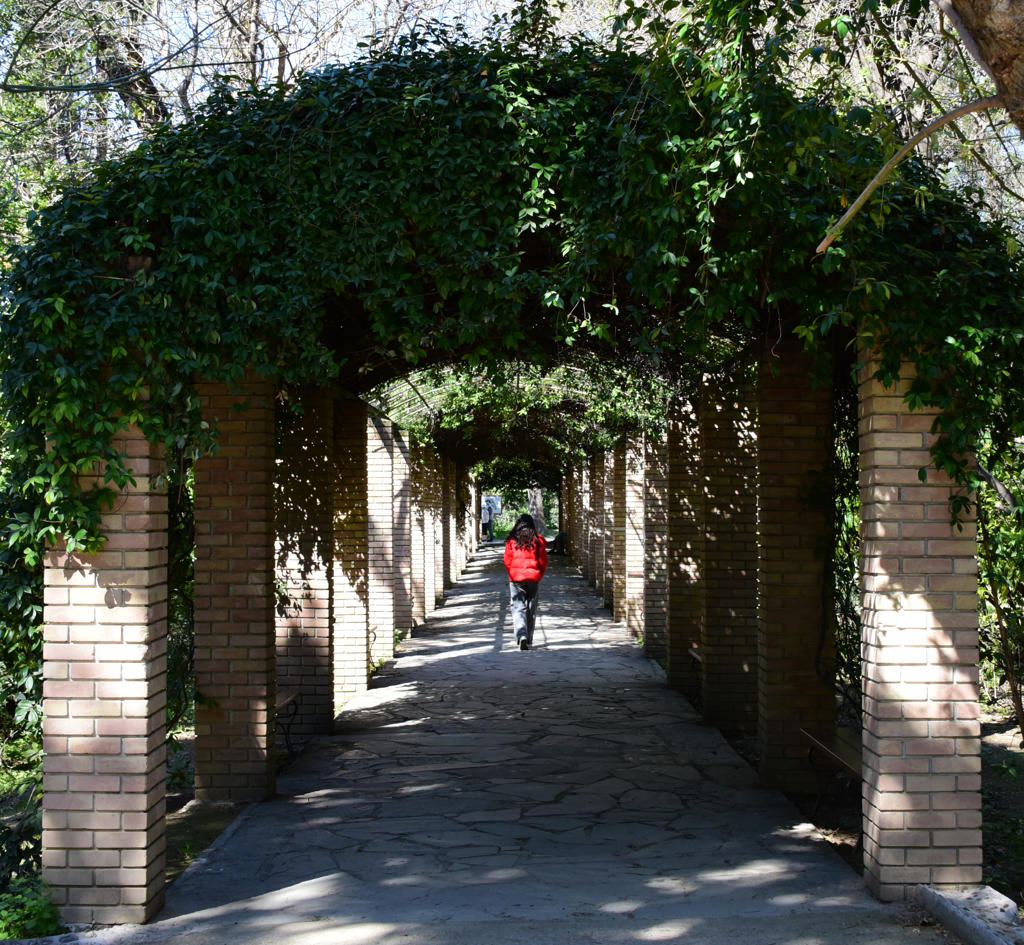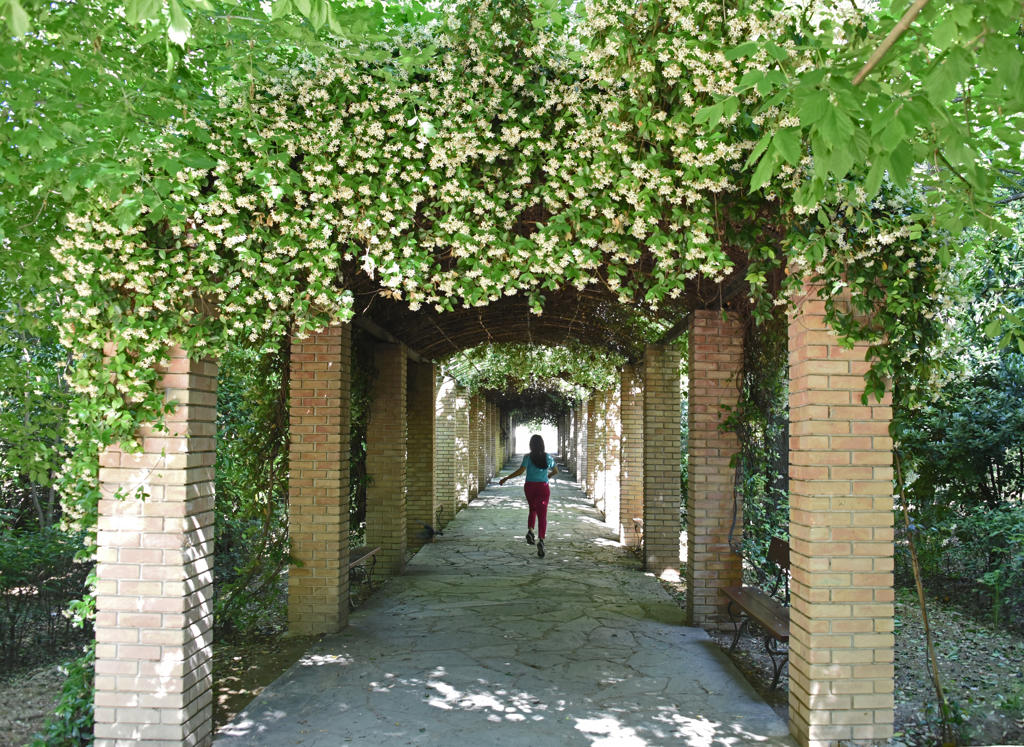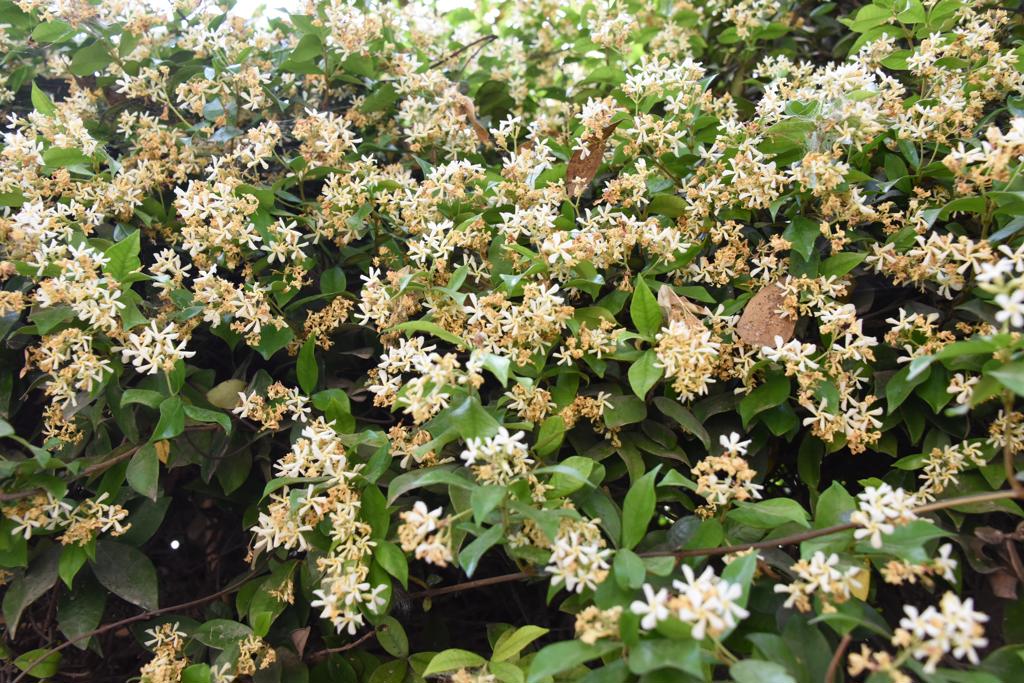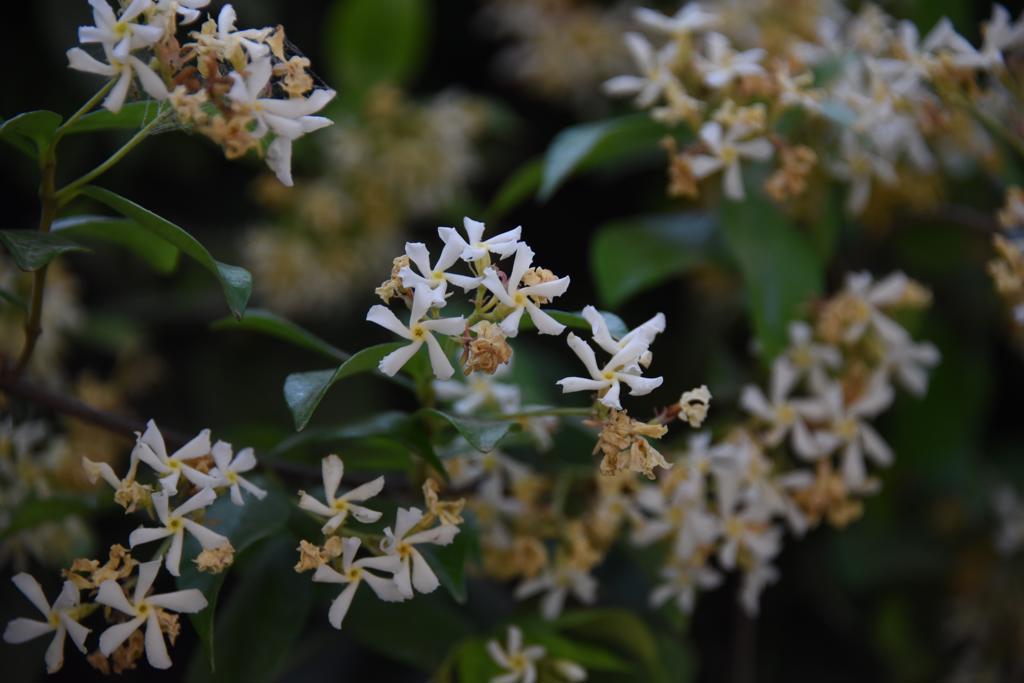


Subtropical, mainly on sunlit forest edges and shrublands. In its natural distribution it occurs in mountain ecosystems, along stream banks, forest edges, and mixed forest environments. It is a plant that prefers warm and humid climates, showing moderate cold tolerance but sensitivity to extreme low temperatures.
(height, leaf arrangement, leaf shape, root system)
It is an evergreen, woody climbing plant (liana), which can reach a length of up to 10 m, usually around 3 m in cultivation. The stem and branches are brown with lenticels, while the young shoots are initially hairy and later become glabrous. When cut, it exudes a white milky sap, characteristic of the Apocynaceae family. Its leaves are opposite, ovate to lance-shaped, acuminate, 2 to 10 cm long and 1 to 4.5 cm wide. They are leathery, glossy, dark green in the summer, and acquire a coppery hue in winter.
(flowering period, flowers, seeds)
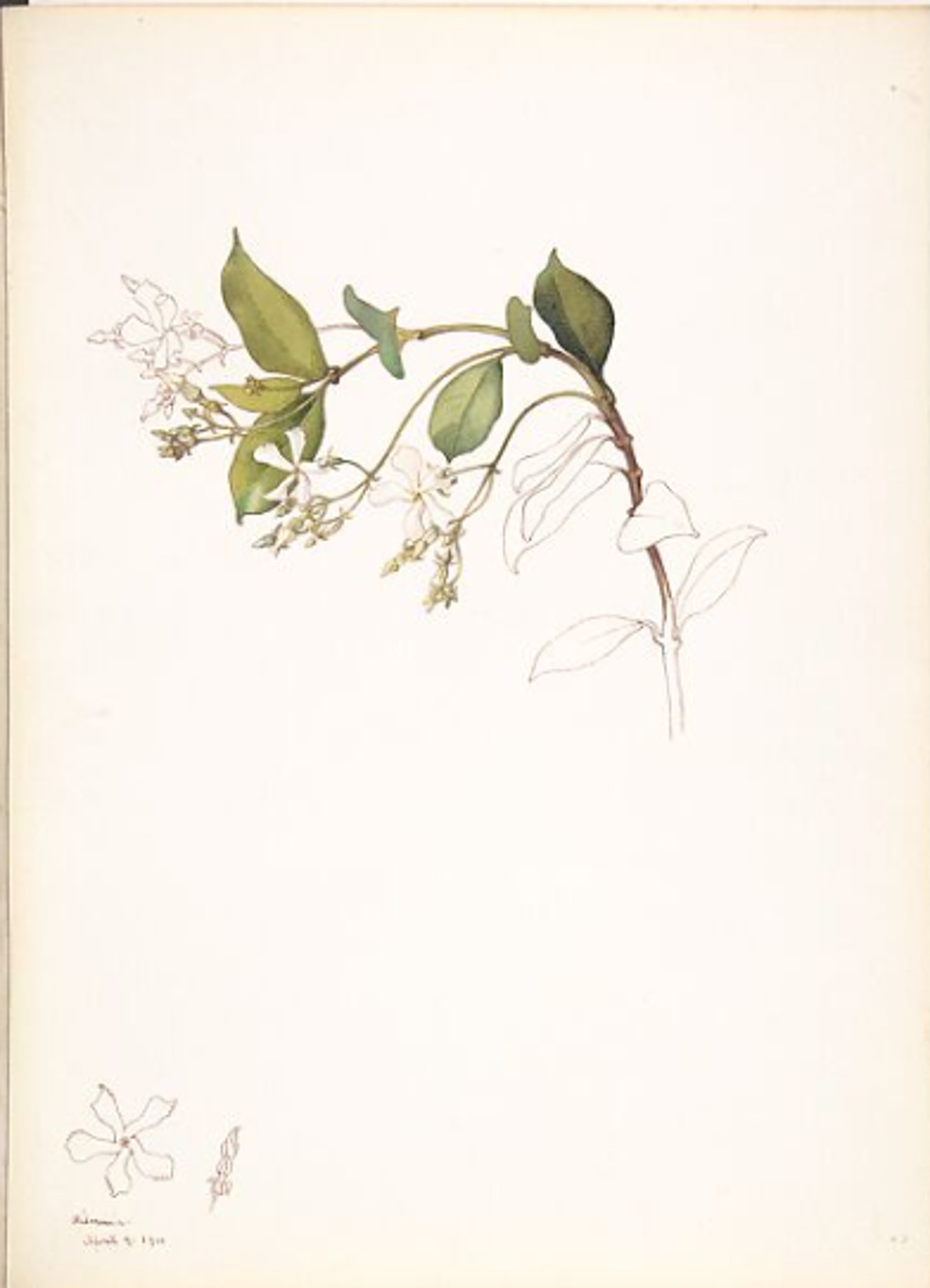
Its flowers appear from spring to early summer (March–August) and are fragrant, white, actinomorphic, 1 to 2 cm in diameter, with a tubular corolla ending in five lobes that curl in a spiral shape. The calyx consists of five narrow, smooth or slightly hairy sepals, 2 to 5 mm long, much smaller than the corolla. The fruits develop from June to December and are linear pods 10 to 25 cm long, containing elongated seeds (1.5–2 cm) with a tuft of long hairs (1.5 to 4 cm) that facilitate wind dispersal. Reproduction occurs mainly asexually through cuttings, but also sexually by seeds.
Its strongly fragrant flower resembles jasmine (Jasminum spp.) however, the flower lobes twist counterclockwise, unlike jasmine. Additionally, the plant retains its leaves in winter, whereas jasmine is deciduous.
The plant is referred to by the name 络石藤 (Luòshíténg – literally meaning “the climbing plant that weaves around the stone”) in traditional pharmacies as early as the Tang dynasty (7th–10th century), and it is systematically recorded in Li Shizhen’s Běncǎo Gāngmù (本草纲目) (16th century), The species was initially described under the name Rhynchospermum jasminoides by John Lindley in 1846, and was later classified in the genus Trachelospermum by Charles Lemaire in 1851.
It is widely cultivated as an ornamental plant, both in gardens and parks, as a climbing or ground-cover plant, and also in pots on terraces and balconies, due to its fragrant flowers. From its flowers, a valuable essential oil is extracted for use in high-quality perfumery, while in milder form it is used in incense in China, Vietnam, and Thailand. In the 16th-century pharmacological collection of the Ming dynasty, Běncǎo Gāngmù (本草纲目) by Li Shizhen, it is described as a climbing plant whose dried stems with leaves are used to relieve rheumatic arthralgia, musculoskeletal pain, and throat inflammations. In the 16th-century work Běncǎo Gāngmù (Compendium of Materia Medica) by Li Shizhen (16th century) one of the most important works in the history of Chinese medicine, Luòshíténg is described as a plant that “clears heat and removes dampness”. During the Song and Ming dynasties, rural populations and healers primarily utilized the plant’s stems and leaves in the form of decoctions or poultices to treat rheumatism, injuries, and febrile conditions. The leaves and stems contain lignans, flavonoids, and triterpenes, while more recent pharmacological studies highlight lignans as the main bioactive compounds, exhibiting strong anti-inflammatory, analgesic, antibacterial, antiviral, and anticancer activity. Of particular importance is their effect on chronic inflammation, which is associated with diseases such as rheumatoid arthritis and cardiovascular disorders. Although the roots and seeds are used less in traditional medicine, modern chemical analyses show that they also contain bioactive compounds. Finally, strong fiber is produced from the bark, which is used for making ropes, sacks, and paper.
(Note: Ethnobotanical data regarding the medicinal uses of plants must be handled with caution, and their application should be carried out exclusively under medical supervision).
- https://powo.science.kew.org/taxon/urn:lsid:ipni.org:names:82553-1
- https://www.metmuseum.org/art/collection/search/393670
- Choi, J. N., Choi, Y., Lee, J., Noh, I. C., Park, J. W., Choi, W. S., & Choi, J. H. (2012). Anti-inflammatory effects of β-sitosterol-β-D-glucoside from Trachelospermum jasminoides (Apocynaceae) in lipopolysaccharide-stimulated RAW 264.7 murine macrophages. Natural Product Research, 26(24), 2340–2343. https://doi.org/10.1080/14786419.2012.654608
- Huang, Z., Lai, C., Wang, B., Luo, B., Kennelly, E. J., & Tan, Q. (2024). Metabolic profiling and anti-inflammatory verification in the ethnic herbal medicine Trachelospermi Caulis et Folium. Traditional Medicine Research, 9(5), 29. https://doi.org/10.53388/tmr20231115003
- Kumari, R., & Sahu, S. K. (2022). A new insights into multicolor emissive carbon dots using Trachelospermum jasminoides leaves for the application of WLEDs. Colloids and Surfaces A: Physicochemical and Engineering Aspects, 647, 128959. https://doi.org/10.1016/j.colsurfa.2022.128959
- Sheu, M., Chou, P., Cheng, H., Wu, C., Huang, G., Wang, B., Chen, J., Chien, Y., & Huang, M. (2009). Analgesic and anti-inflammatory activities of a water extract of Trachelospermum jasminoides (Apocynaceae). Journal of Ethnopharmacology, 126(2), 332–338. https://doi.org/10.1016/j.jep.2009.08.019
- Tan, X., Guo, L., Qiu, Y., Chen, H., & Tan, C. (2010). Chemical constituents of Trachelospermum jasminoides. Natural Product Research, 24(13), 1248–1252. https://doi.org/10.1080/14786410903244962
- Yu, H., Zhuo, Z., He, Z., Liu, Q., Deng, X., & Xu, D. (2025). Distribution of Trachelospermum jasminoides under the influence of different environmental factors. Agriculture, 15(3), 285. https://doi.org/10.3390/agriculture15030285
- Zhao, Z., He, X., Zhao, Y., Sun, Y., Chen, X., Cun, Y., Huang, L., Bai, Y., & Zheng, X. (2017). Phytochemistry, pharmacology and traditional uses of plants from the genus Trachelospermum L. Molecules, 22(9), 1406. https://doi.org/10.3390/molecules22091406
During each season you will see:
SPRING
Young shoots and leaves,
onset of flowering.
SUMMER
Abundant flowering,
leaves, onset of fruiting.
AUTUMN
Leaves,
fruit
WINTER
Leaves
References in Αrt
A watercolor of the species, created in 1911 by M. N. Armstrong, is preserved at the Metropolitan Museum of Art.