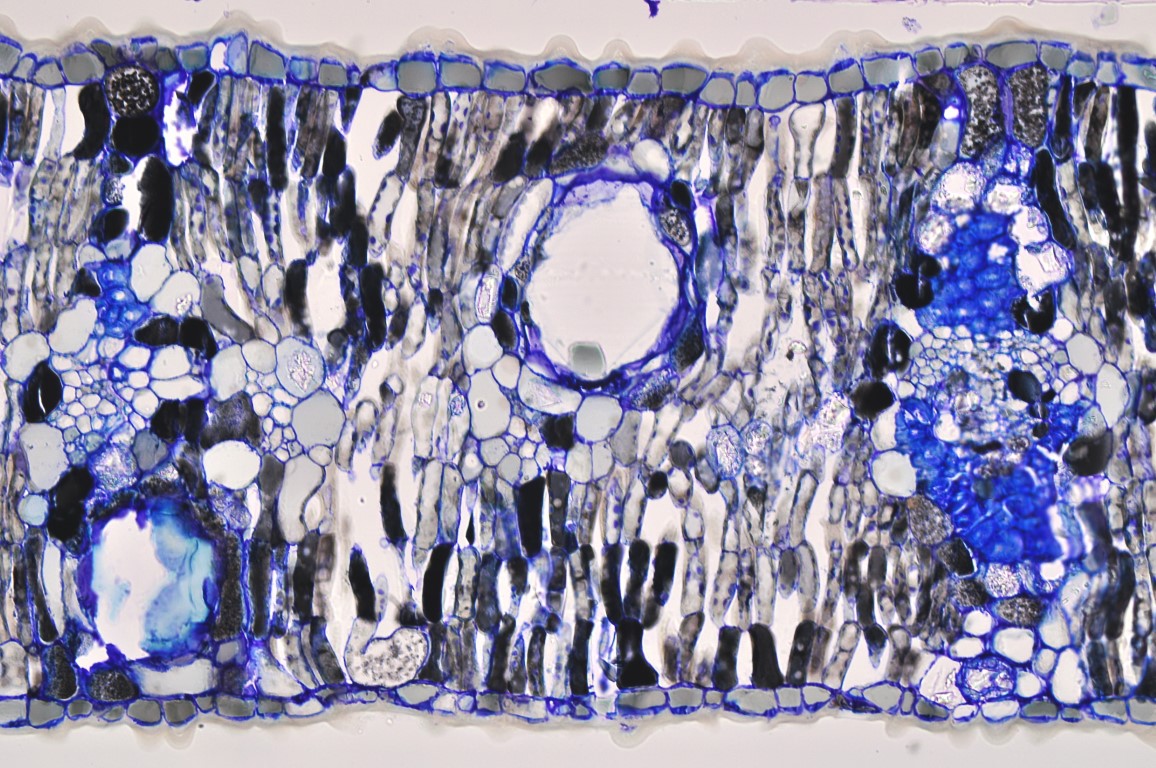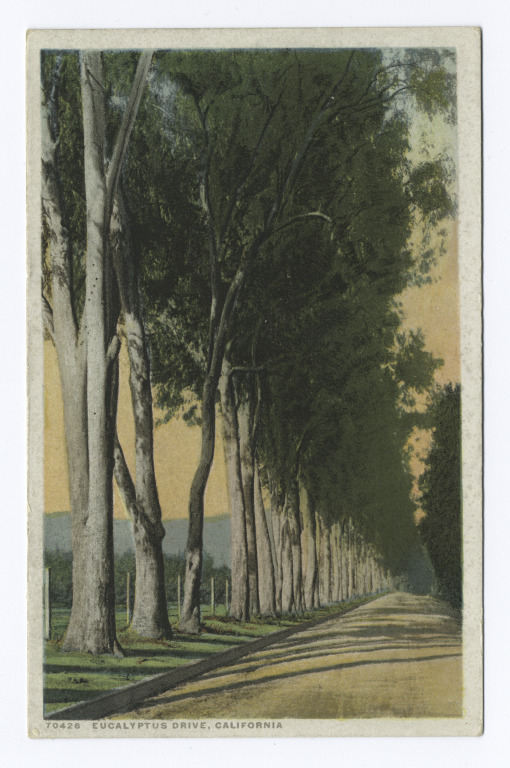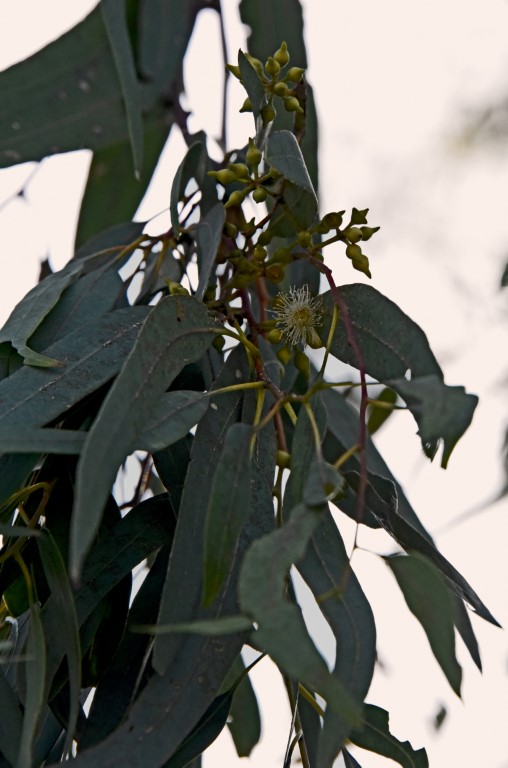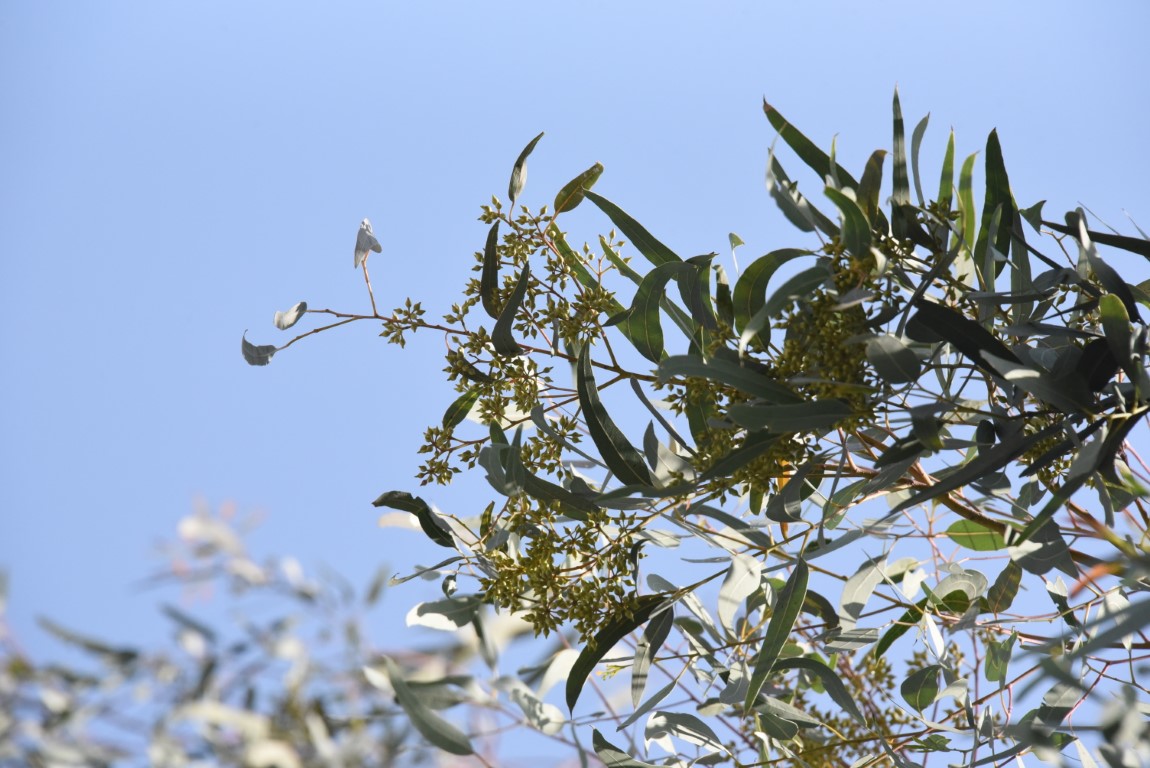


Classified as “Phanerophyte (P)”. Its habitat is “Agricultural and Ruderal habitats (R)”. Trees of the species Eucalyptus camaldulensis grow in ecosystems of surface flowing waters and in open forests. They can grow under varied climatic conditions, as they are resistant to extreme temperatures (-6°C – 54°C) and to drought.
(height, leaf arrangement, leaf shape, root system)
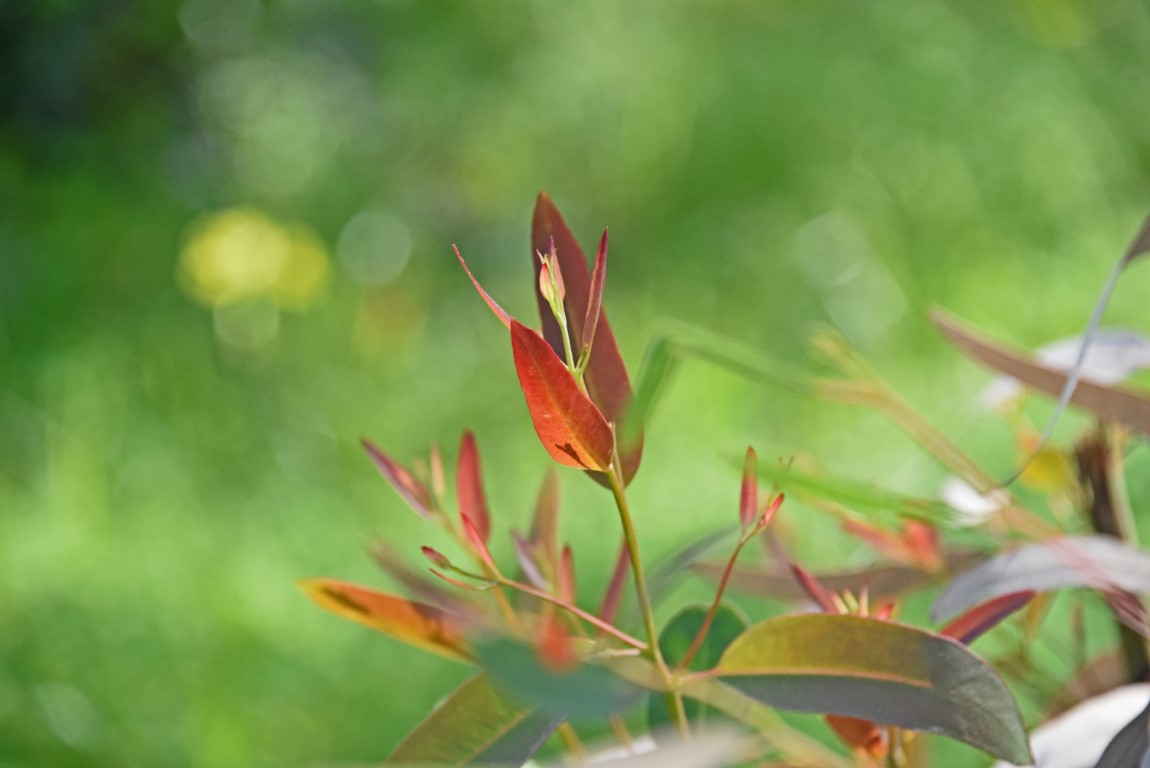
The trees reach heights of up to 30 m and occasionally even 50 m. The bark is smooth, white-grey in color, and peels off in strips. The young leaves are narrow and lanceolate, have a blue-green color, and grow opposite each other. The mature leaves grow alternately, have a dull green-grey color, and are broadly lanceolate, petiolate (stalked), with a length of 12-22 cm. The foliage is maintained throughout the year; therefore, the species is evergreen.
Regarding the root system, it is particularly developed, as the taproot is very strong, while the lateral roots can reach a length of up to 2.5 times the height of the tree. These characteristics increase the effectiveness of the trees in combating soil erosion and stabilizing it.
(flowering period, flowers, seeds)
It is a monoecious species, with its flowers possessing both male and female reproductive organs. They are organized in small umbels of 7-11 groups. Flowering occurs from late spring to early summer between May and June. The fruits are woody hemispherical capsules 2-5 mm long and 4-10 mm wide. About 15 seeds are contained per fruit, which are yellow-brown and irregular in shape.
The trees of the species stand out for their great height, the variations in bark coloration, and their large lanceolate leaves.
River Red Gum was introduced to Europe in the late 18th and early 19th centuries, within the context of increasing European scientific and economic engagement with Australian flora. After the European colonization of Australia, species of the genus Eucalyptus attracted intense interest due to their rapid growth, adaptability, and multiple uses. Seeds of E. camaldulensis were initially transported to botanical gardens in the Mediterranean, with a characteristic example being the botanical garden of Naples, near the Camaldoli monastery, from where its scientific name is derived. There, it was successfully cultivated and scientifically described in 1832 by Frederick Dehnhardt. Subsequently, the species spread widely in countries of southern Europe, mainly for forest plantations, and primarily for draining swamps and limiting malaria (drainage works of marshy areas), production of timber and firewood, but also as an ornamental tree, marking the beginning of its European expansion.
The species’ long-standing presence in the Australian landscape is closely linked to the traditional knowledge and practices of Aboriginal populations, who utilized it extensively in their ethnobotany. The leaves, bark, and gum were used as therapeutic agents for respiratory and gastrointestinal ailments, wound healing, and controlling bleeding, while smoke from burning leaves was applied in ritual and healing practices to treat fevers and infections. Since the time of Aboriginal populations, it was used for the construction of canoes and shields. Today, scientific research has shown that the leaves of the species have a high content of essential oil (1,8-cineole) with pharmaceutical properties, as it is anti-inflammatory, antiseptic, and antimicrobial. It is also used to produce cosmetic preparations. The smoke produced during the burning of leaves has insect-repellent action. Wood from trees is used to make building materials, firewood, charcoal and paper pulp. It is also used for honey production, as well as for the restoration of degraded soils, stabilization of riverbanks, and creation of habitats for fauna, highlighting the dual importance of Eucalyptus camaldulensis as an ethnobotanically and economically significant forest species.
(Note: Ethnobotanical data regarding the medicinal uses of plants must be handled with caution, and their application should be carried out exclusively under medical supervision).
- https://www.worldfloraonline.org
- https://floranorthamerica.org
- https://www.montreal-process.org
- https://www.anbg.gov.au/stamps/stamp-proc-SA-1936.html
- https://apps.worldagroforestry.org
- https://www.fao.org
- Butcher, P. A., McDonald, M. W., & Bell, J. C. (2008). Congruence between environmental parameters, morphology and genetic structure in Australia’s most widely distributed eucalypt, Eucalyptus camaldulensis. Tree Genetics & Genomes, 5(1), 189–210. https://doi.org/10.1007/s11295-008-0169-6
- Del Moral, R., & Muller, C. H. (1970). The allelopathic effects of Eucalyptus camaldulensis. The American Midland Naturalist, 83(1), 254–276. https://doi.org/10.2307/2424020
- Dimopoulos, P., Raus, T., Bergmeier, E., Constantinidis, T., Iatrou, G., Kokkini, S., Strid, A., & Tzanoudakis, D. (2013). Vascular plants of Greece: An annotated checklist. Botanic Garden and Botanical Museum Berlin-Dahlem; Hellenic Botanical Society. https://doi.org/10.3372/en.31
- Doody, T. M., Benger, S. N., Pritchard, J. L., & Overton, I. C. (2014). Ecological response of Eucalyptus camaldulensis (river red gum) to extended drought and flooding along the River Murray, South Australia (1997–2011) and implications for environmental flow management. Marine and Freshwater Research, 65(12), 1082–1093. https://doi.org/10.1071/mf13247
- Hirsch, H., Allsopp, M. H., Canavan, S., Cheek, M., Geerts, S., Geldenhuys, C. J., Harding, G., Hurley, B. P., Jones, W., Keet, J., Klein, H., Ruwanza, S., Van Wilgen, B. W., Wingfield, M. J., & Richardson, D. M. (2019). Eucalyptus camaldulensis in South Africa – past, present, future. Transactions of the Royal Society of South Africa, 75(1), 1–22. https://doi.org/10.1080/0035919x.2019.1669732
- Mullins, K. V., Llewellyn, D. J., Hartney, V. J., Strauss, S., & Dennis, E. S. (1997). Regeneration and transformation of Eucalyptus camaldulensis. Plant Cell Reports, 16(11), 787–791. https://doi.org/10.1007/s002990050321
- Sabo, V. A., & Knezevic, P. (2019). Antimicrobial activity of Eucalyptus camaldulensis Dehn. plant extracts and essential oils: A review. Industrial Crops and Products, 132, 413–429. https://doi.org/10.1016/j.indcrop.2019.02.051
- Unsal, O., Korkut, S., & Atik, C. (2003). The effect of heat treatment on some properties and colour in eucalyptus (Eucalyptus camaldulensis Dehn.) wood. Maderas. Ciencia y Tecnología, 5(2), 145–152. https://doi.org/10.4067/s0718-221×2003000200006
During each season you will see:
SPRING
Leaves
Flowers
SUMMER
Leaves
Flowers
Woody fruit capsules
AUTUMN
Leaves
Open capsules that have dispersed their seeds.
WINTER
Leaves
Bark peeling
References in Αrt
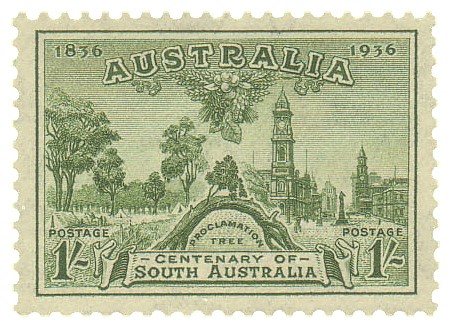
The species has been depicted in paintings, and there are even poems in its honor, such as “Eucalyptus camaldulensis” by Jen Webb. The form of the tree has been captured on Australian stamps as well. Specifically, on the commemorative stamp of the year 1936, this eucalyptus is referred to as the “Proclamation tree”, since it was the tree under which the State of South Australia was proclaimed in 1836, 100 years prior.