

Tuarts form part of coastal shrub ecosystems in areas with deep sand. They are often found in limited forest communities along the coasts. The Mediterranean climate is ideal for their growth, with the optimal temperature range extending from 20 °C to 38 °C. They also exhibit resilience to more extreme temperatures ranging from 3 °C to 43 °C and are drought resistant.
(height, leaf arrangement, leaf shape, root system)
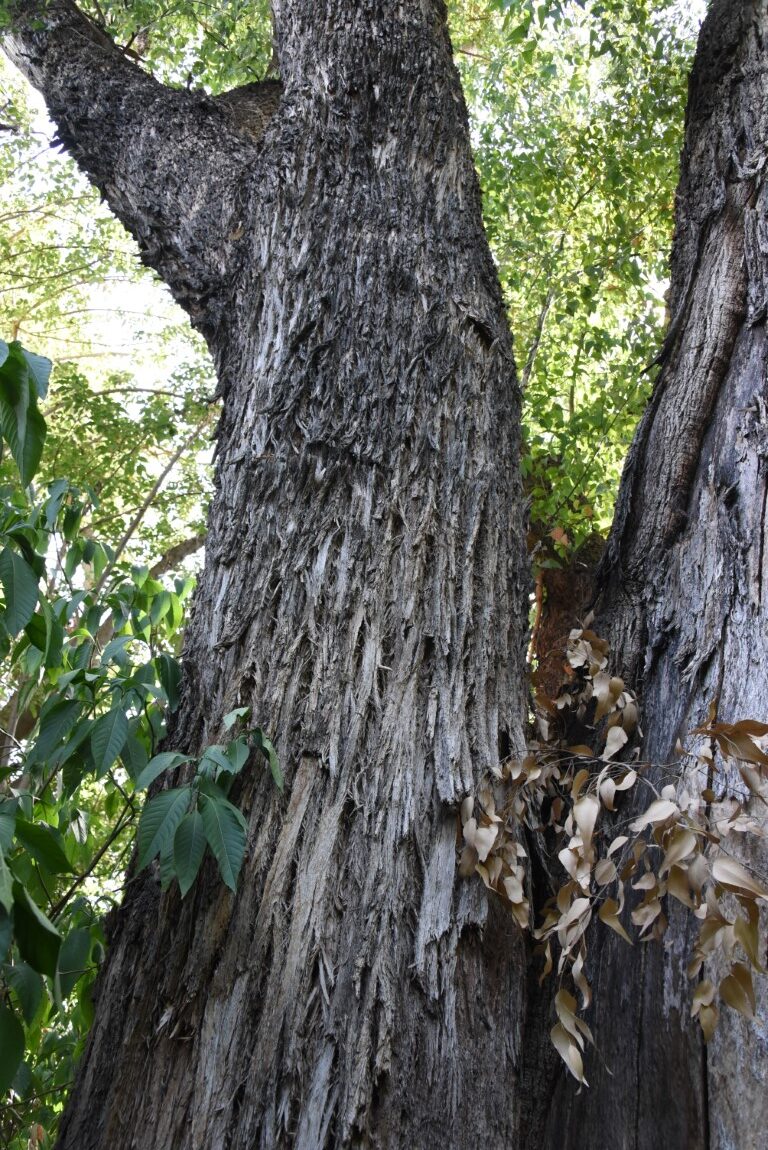
The height of the trees ranges between 10 and 40 m, with the tallest recorded individual of the species reaching 47 m (Tuart Forest National Park). The crown of the trees can reach a diameter of 25 m. Their bark is rough along the length of the trunk and the main branches. It has a dark grey color and a fibrous surface, with the older parts peeling off. The smaller branches have a circular cross-section.
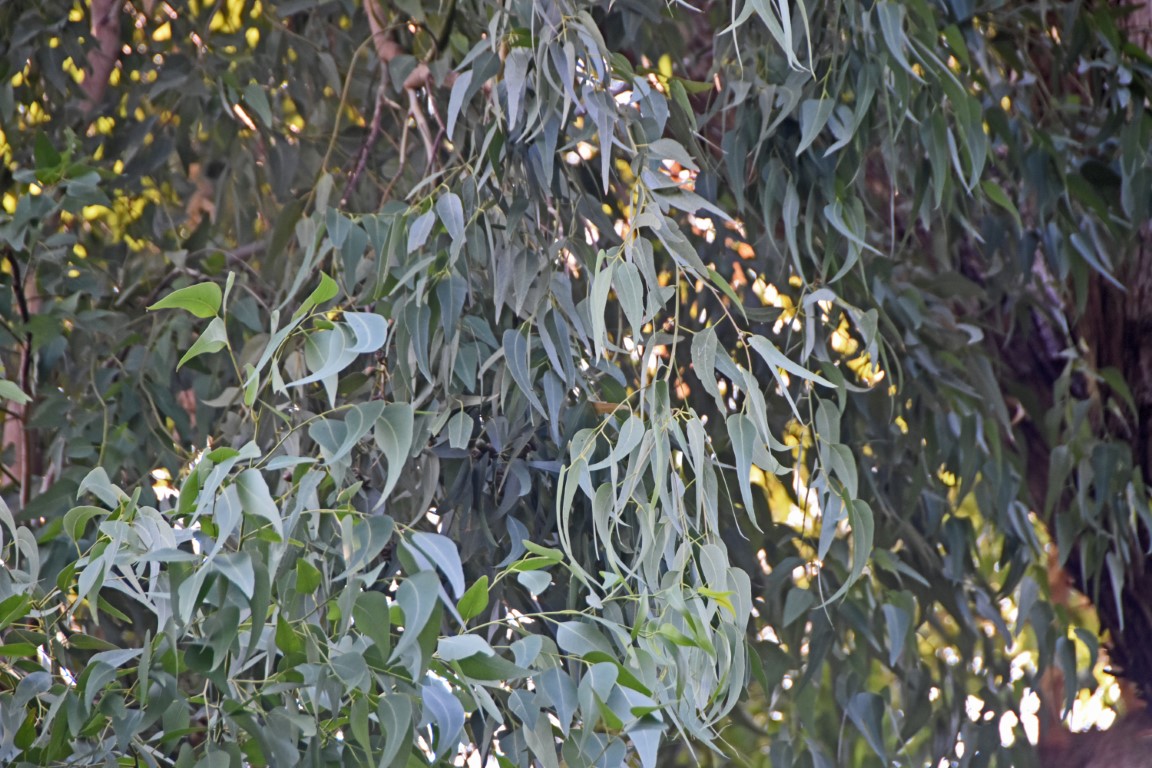
The young leaves are petiolate, with the first 4-8 pairs on the stem presenting an opposite arrangement, while the next pairs are arranged alternately. They are light green, ovate to heart-shaped, 9–15 cm long and 5.5–9.5 cm wide. The mature leaves are arranged alternately, have an ovate to lanceolate or sickle-like shape, light green color, small thickness, and a glossy surface. Their blade is 1-18 cm long and 1.5-3 cm wide, while it often exhibits curvature. They are connected to the stem via a petiole, which can be 1-3 cm long. The foliage is maintained throughout the year (evergreen species).
The root system of the species allows survival under drought conditions, as it possesses a central taproot that can reach a depth of 3 m, through which water accumulated in the deeper soil layers during dry periods is absorbed. It also has surface roots which extend in a radius of 8-12 m, favoring the immediate absorption of water during the first rainfalls.
(flowering period, flowers, seeds)
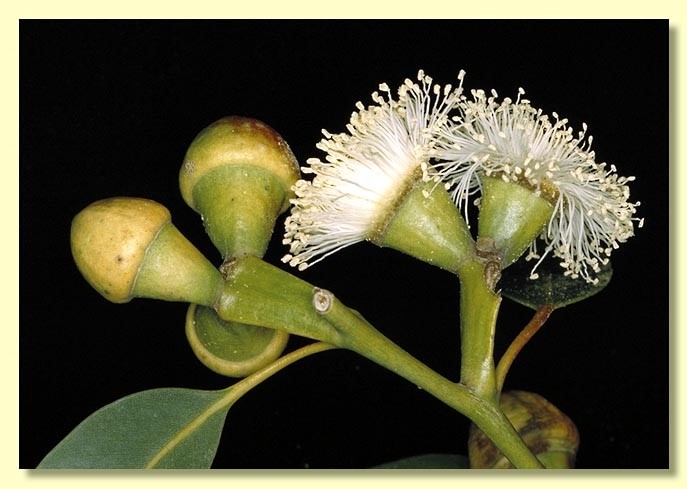
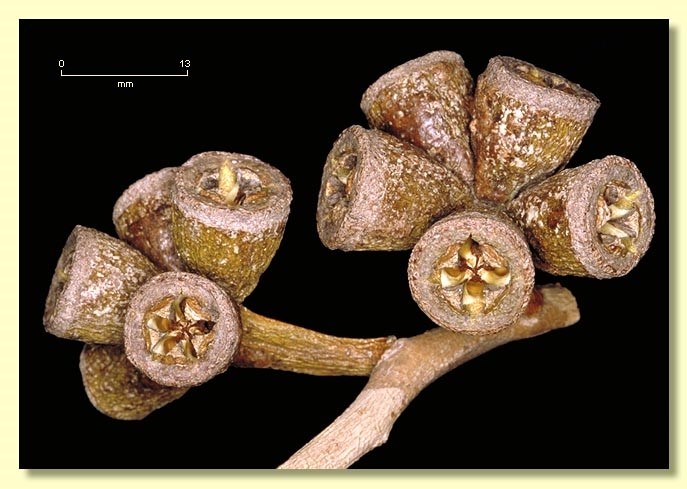
The flowers of Eucalyptus gomphocephala are hermaphroditic, meaning they possess both male and female reproductive organs. The inflorescences are axillary and unbranched, with each one possessing 7 white-yellow flowers. Each flower originates from a flower bud 8-10 cm long. At the flower bud stage, the flower is completely covered by the perianth (cap), a fact that was the reason for the genus name “Eucalyptus” (from Greek “eu” = well + “kalypto” = to cover). The stalk is 13-27 mm long, to which the sessile flowers are connected. Flowering takes place during the period of January – April. The fertilized flowers turn into narrow fruits, usually pedicellate (stalked), cup-shaped, 1-2.5 cm long and 1.2-1.8 cm wide. They contain dark-colored flattened disc-shaped or ovoid seeds, which they release after approximately 1 year.
Tuart trees stand out for their great heightand their ability to thrive in sandy ecosystems. Eucalyptus gomphocephala is a keystone species, as it provides shelter to birds, mammals, reptiles, and insects, while their lifespan can exceed 400 years.
The species was officially described for the first time by the botanist Augustin Pyramus (de Candolle) in the third volume of the “Prodromus Systematis Naturalis Regni Vegetabilis”, which was published in 1828. The epithet “gomphocephala” arises from the Greek words “gómphos” (bolt/peg) and “kephale” (head), as the shape of the fruit resembles a bolt, specifically a wooden connector. In the mid-19th century, this species was heavily exploited for timber in Perth, Australia, leading to a significant population decline by the early 20th century. Consequently, since 2019, the species has been classified as “Vulnerable” on the IUCN Red List of Threatened Species, with ongoing efforts focused on its conservation.
Beyond its significant ecological role as a dominant species of the coastal forest ecosystems of the Swan Coastal Plain, Eucalyptus gomphocephala also presents interest from an ethnobotanical and pharmacognostic perspective. Although its traditional use by indigenous populations has not been documented as extensively as other eucalyptus species, E. gomphocephala belongs to a genus generally utilized by Aborigines for medicinal and practical purposes. Modern studies have highlighted that extracts of the species are rich in phenolic compounds with strong antioxidant activity, a fact that suggests potential traditional or future pharmaceutical utilization. These compounds exhibit the ability to neutralize free radicals and biological activity, reinforcing interest in the use of the species in pharmaceutical and cosmetological research. Moreover, it has historically been used mainly for its timber, which is extremely durable and suitable for heavy construction, infrastructure, and fuel, uses that fall more into later European exploitation. Today, the greatest value of the species lies in its rarity and the heritage it carries.
(Note: Ethnobotanical data regarding the medicinal uses of plants must be handled with caution, and their application should be carried out exclusively under medical supervision).
- https://www.worldfloraonline.org
- https://www.cabidigitallibrary.org
- https://temperate.theferns.info
- https://www.iucnredlist.org
- Al-Sayed, E., Martiskainen, O., Bobrowska-Hägerstrand, M., Sinkkonen, J., Törnquist, K., Pihlaja, K., Ayoub, N., & Singab, A. (2010). Phenolic compounds from Eucalyptus gomphocephala with potential cytotoxic and antioxidant activities. Natural Product Communications, 5(10), 1639–1642. https://doi.org/10.1177/1934578×1000501025
- Close, D. C., Davidson, N. J., & Swanborough, P. W. (2011). Fire history and understorey vegetation: Water and nutrient relations of Eucalyptus gomphocephala and E. delegatensis overstorey trees. Forest Ecology and Management, 262(2), 208–214. https://doi.org/10.1016/j.foreco.2011.03.025
- De Candolle, A. P., & De Candolle, A. (1824–1873). Prodromus systematis naturalis regni vegetabilis, sive, Enumeratio contracta ordinum generum specierumque plantarum huc usque cognitarium, juxta methodi naturalis, normas digesta. Sumptibus Sociorum Treuttel et Würtz.
- Nevill, P. G., Bradbury, D., Williams, A., Tomlinson, S., & Krauss, S. L. (2013). Genetic and palaeo-climatic evidence for widespread persistence of the coastal tree species Eucalyptus gomphocephala (Myrtaceae) during the Last Glacial Maximum. Annals of Botany, 113(1), 55–67. https://doi.org/10.1093/aob/mct253
- Scott, P. M., Shearer, B. L., Barber, P. A., & St J. Hardy, G. E. (2012). Relationships between the crown health, fine root and ectomycorrhizae density of declining Eucalyptus gomphocephala. Australasian Plant Pathology, 42(2), 121–131. https://doi.org/10.1007/s13313-012-0152-4
- Taylor, K., Barber, P. A., St J. Hardy, G. E., & Burgess, T. I. (2008). Botryosphaeriaceae from tuart (Eucalyptus gomphocephala) woodland, including descriptions of four new species. Mycological Research, 113(3), 337–353. https://doi.org/10.1016/j.mycres.2008.11.010
During each season you will see:
SPRING
Leaves
Flowers
SUMMER
Crown rich with leaves
Woody fruit capsules
AUTUMN
Fall of mature leaves
Release of seeds from the ripe fruits
WINTER
Leaves
Flowers
Bark peeling