
It develops in a sub-humid Mediterranean climate with subtropical characteristics, where it can withstand extremely low rainfall (below 200 mm per year) thanks to its ability to collect moisture through its canopy. Its ecosystem consists mainly of thermophilous forests and xerophytic vegetation. It does not tolerate low temperatures below −10 °C or frost.
(height, leaf arrangement, leaf shape, root system)
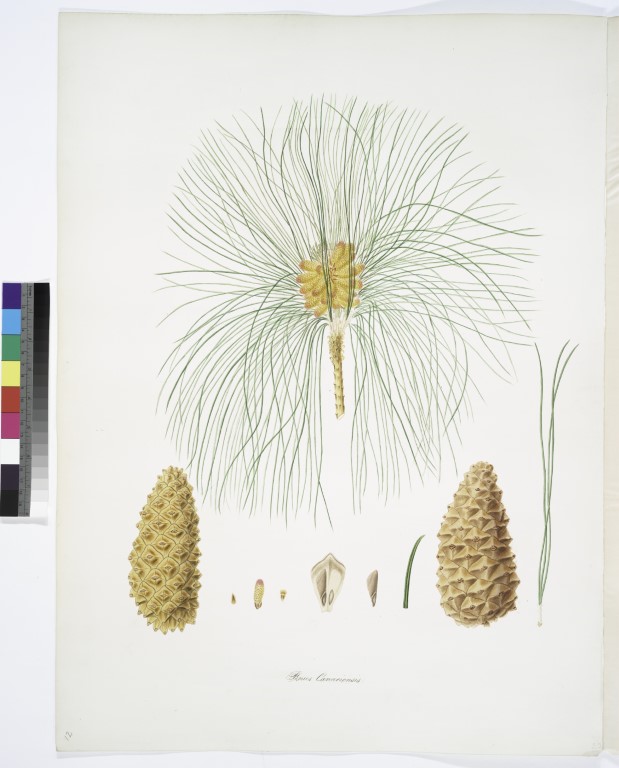
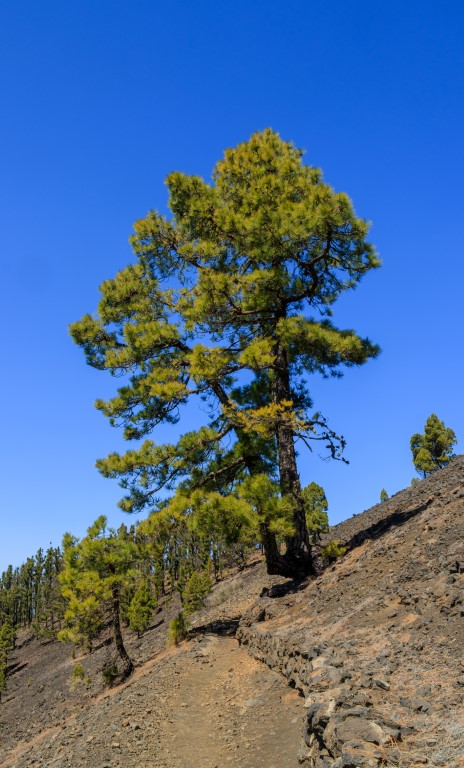
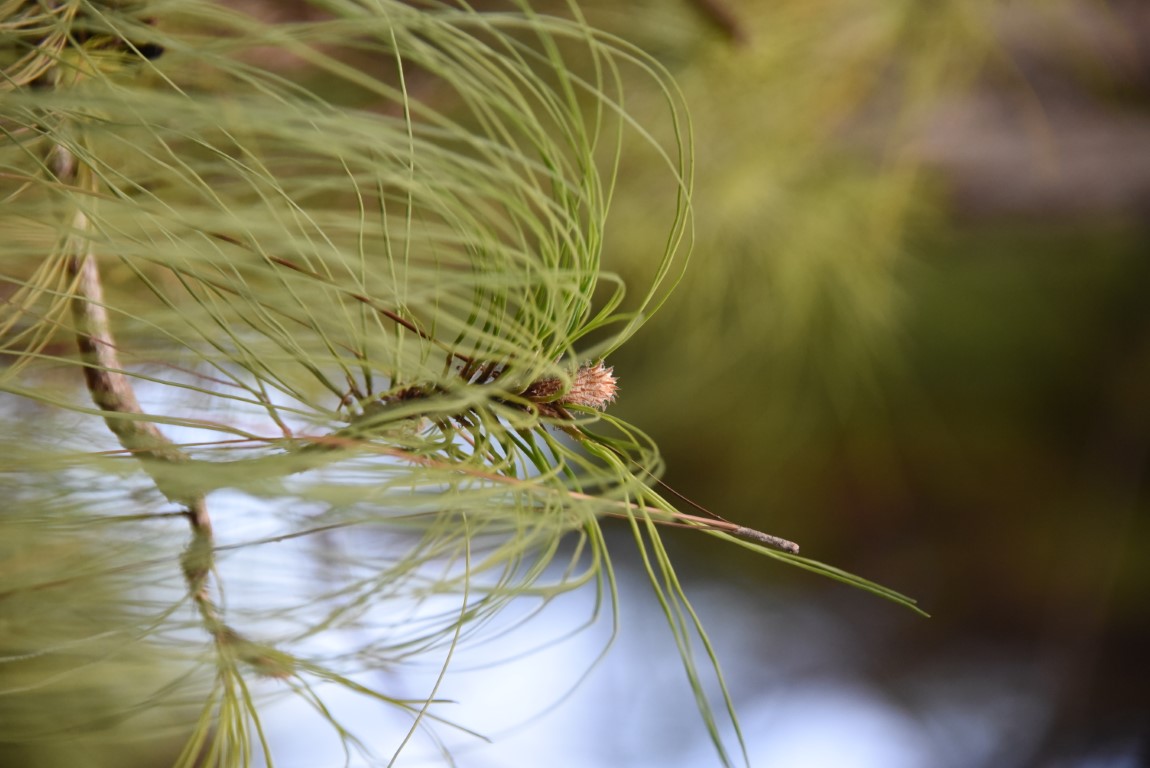
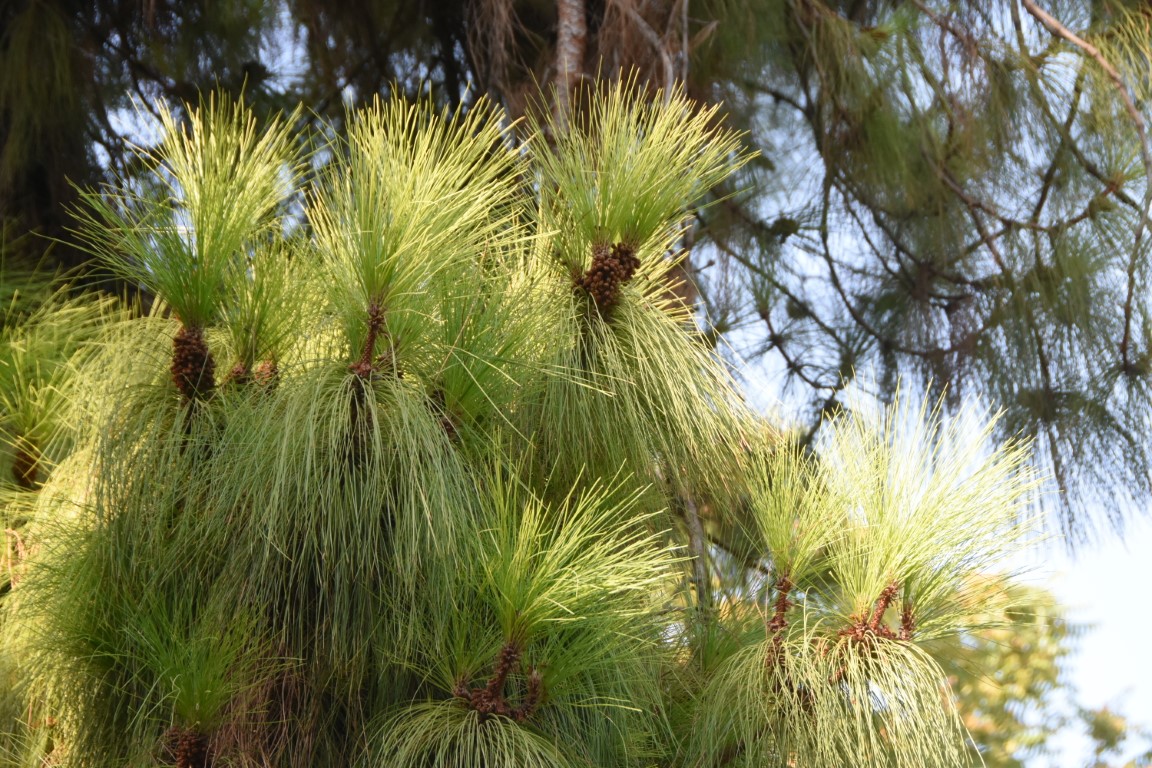
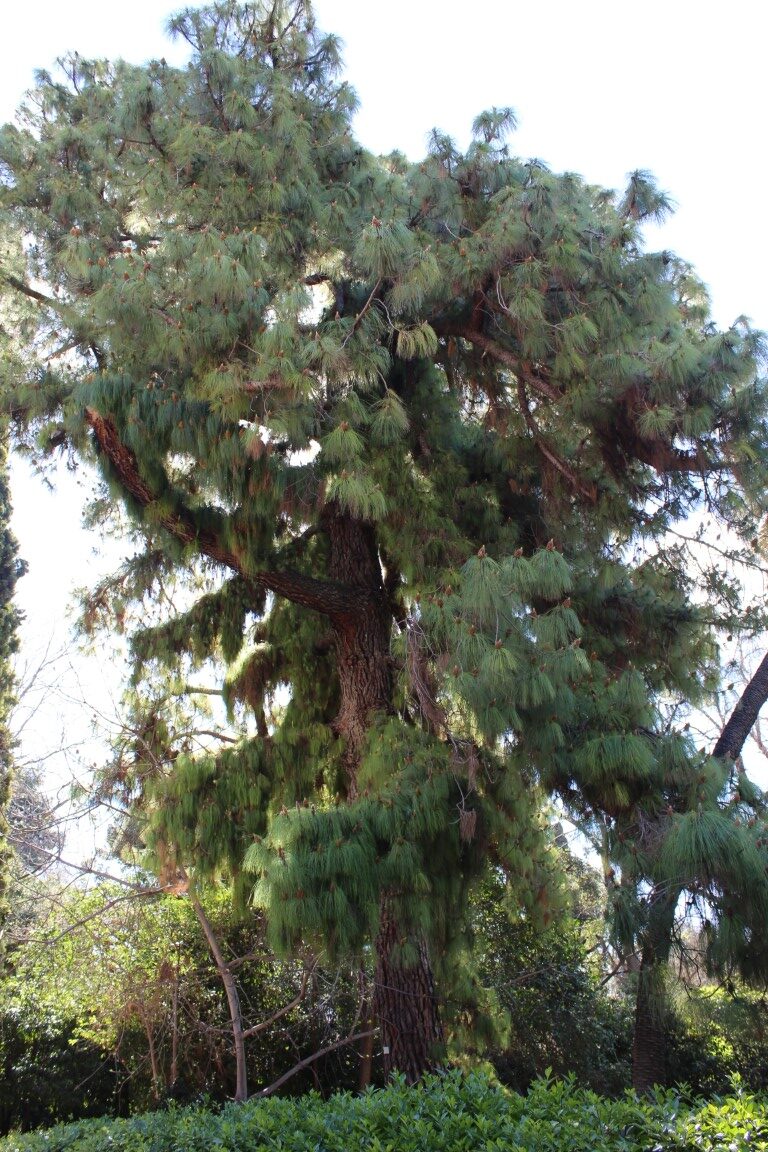
An evergreen gymnosperm that typically reaches 30–40 m in height and a trunk diameter of about 1–1.5 m, while in exceptional cases it may exceed 55–60 m in height and 2–2.5 m in diameter. The main branches rise at an angle. In young individuals the crown is narrow and conical; with maturity it develops into a broader ovoid–conical form, and in very old trees it often becomes irregular and dense. The trunk is usually straight, and the bark is very thick, reddish-brown to pale yellowish, with deep fissures and a scaly texture. The leaves are needle-like, arranged in fascicles of three, 15–30 cm long and about 1 mm thick, with serrated margins and conspicuous stomatal pores on both surfaces. Needles longer than 20 cm often droop under their own weight, giving the tree a characteristic “pendulous” appearance. Their colour ranges from bright green to yellowish green. The needles remain on the tree for 1.5–3 years before being replaced. A distinctive feature of the species is the production of epicormic shoots from the trunk, bearing glaucous-green juvenile leaves 3–6 cm long, which appear mainly after fires or mechanical damage. This mechanism makes it one of the most fire-resistant conifers in the world, capable of resprouting even after intense fires that have destroyed the foliage crown.
(flowering period, flowers, seeds)
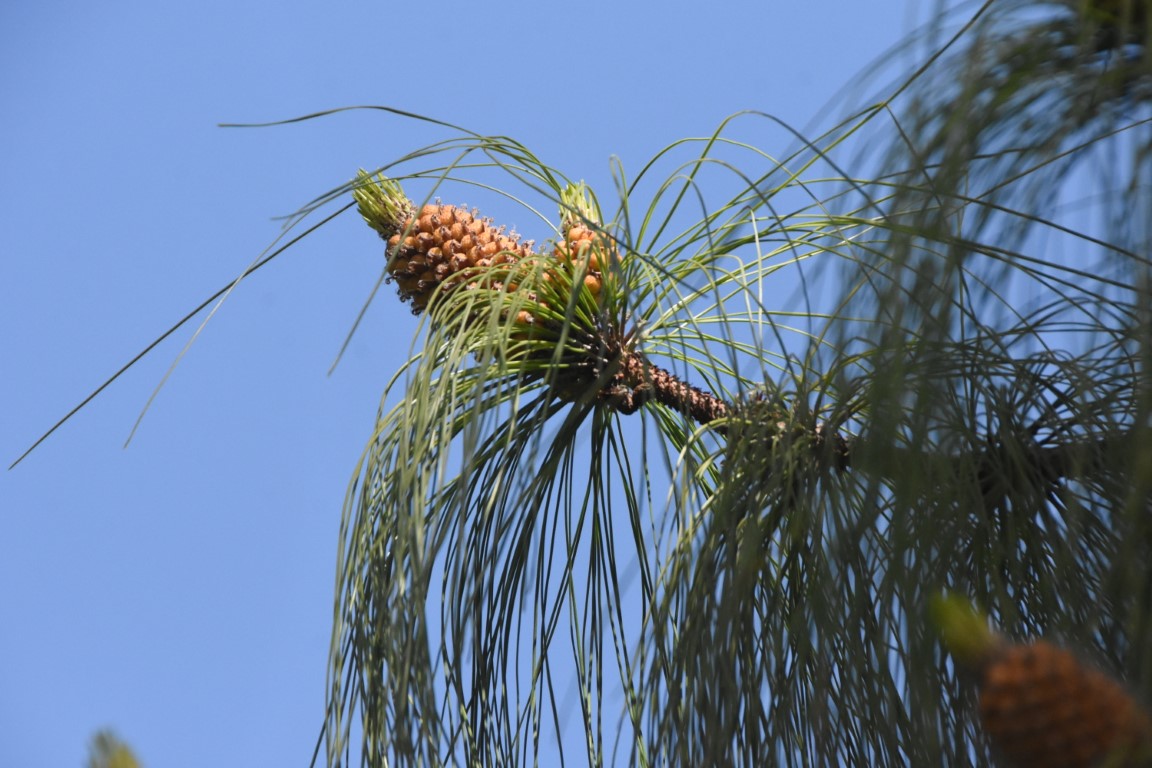
It is a monoecious species, bearing both male and female flowers on the same tree. The flowering period extends from late March to early June, in trees older than 10–20 years, or in some cases even 40 years. The male flowers are small, yellowish to yellow-green, often with a spiny appearance, and occur in numerous dense clusters at the tips of the branches. The female flowers are reddish-purple, slightly elongated, and develop singly or in small groups of 2–3. The cones are woody, ovoid-conical, 10–20 (up to 23) cm long and 5–10 cm wide, with a deep glossy brown colour. They are often slightly curved, borne on short, thick stalks, and oriented downward or obliquely. The scales are thick, hard, and shiny, with relatively blunt apices. Maturation is completed about two years after pollination (around April), while opening may occur in the same summer or even one year later. Cones often remain closed for several years, opening after exposure to high temperatures, for example as a result of fire. The seeds are 11–15 mm long and 6–7 mm wide, glossy dark brown to black on the upper surface and matte grey on the lower, and bear a firmly attached wing 15–25 mm long, ranging in colour from whitish to reddish, with characteristic dark brown streaks. This wing facilitates wind dispersal. In addition to reproduction by seeds, the species also shows an exceptional capacity for vegetative regeneration after fire or other disturbance—an unusual trait for the genus—through the production of epicormic shoots from the trunk.
It is the tallest tree in the Canary Islands, with the tallest known specimen, the “Pino de las Dos Pernadas” near Vilaflor on Tenerife, reaching a height of 56.7 metres. Very few old-growth trees remain on the islands, due to the extensive logging of the species in the past. When the needles exceed 20 cm in length, they pendulate due to their mass, providing the tree with its typical pendulous habit.
Pinus canariensis is considered a paleoendemic species, whose current distribution in the Canary Islands represents a relict of a much broader historical range. Paleobotanical evidence suggests that closely related pine species were widely distributed across Europe and the Mediterranean region during the Neogene period (approx. 23 million years ago), forming part of the broader Mediterranean–Tethys flora that extended from the Himalayas to the western limits of the ancient Tethys Sea. Tectonic and climatic shifts during the Neogene led to the contraction and eventual extinction of these lineages in continental Europe, while oceanic islands, such as the Canaries, served as refugia for the survival of specific populations. Phylogenetic studies indicate that P. canariensis shares a close genetic affinity with several Mediterranean pines, including P. pinea, P. brutia, P. halepensis, P. pinaster, and P. heldreichii.
Today, the species is endemic to five islands of the Canarian archipelago (Tenerife, La Palma, Gran Canaria, La Gomera, and El Hierro), where it forms extensive forests across a broad altitudinal range and diverse ecological conditions. The oldest reliable fossils of the genus Pinus on the islands date back to the Pliocene (approx. 3.9–3.1 million years ago), suggesting that the presence of the species in the archipelago is relatively ancient, though potentially more recent than previously estimated. Fossils of the species have been described from the Early Pliocene in Turkey, while fossilized cones and seeds have been recovered from the Late Miocene in the Vienna Basin. Additionally, cone casts including seeds of a species likely ancestral to P. canariensis have been identified in the Kallithea region of Rhodes, dating to the Lower Pleistocene.
One of the most significant ecological attributes of P. canariensis is its exceptional fire resilience. Mature individuals possess thick, insulating bark and pre-formed epicormic buds, which are protected beneath the bark and can survive even intense wildfire events. Following a fire, these buds facilitate rapid resprouting and crown regeneration, even when the above-ground portion of the tree has sustained extensive damage. This capacity, combined with the species’ adaptability to a wide range of environmental conditions, contributes to the maintenance and recovery of Canarian pine forests in fire-prone ecosystems. Consequently, P. canariensis has garnered significant interest for its application in restoration programs for burned areas and forest ecosystems within Mediterranean climates.
Macro-fossil evidence (needles, cones, and seeds) confirms that related forms of the species were previously widespread across Europe; however, climatic and tectonic shifts led to their localized extinction, resulting in the species’ survival solely within the Canary Islands as a geographical refugium.
Due to its high resin content, the aromatic and exceptionally durable wood of Pinus canariensis is regarded as one of the finest among pine species. Historically, it has been utilized extensively as structural timber, while modern applications include its use in the manufacturing of guitars and other string instruments. On the island of La Palma, the wood is traditionally employed for the construction of wine-aging barrels (pipas), producing the unique “vino de tea,” characterized by its distinctive aroma. Furthermore, the species possesses significant ornamental value and is widely cultivated in private gardens, parks, and urban landscapes within warm climates.
From an ecological perspective, the species’ long needles play a critical role in the hydrological cycle of the Canary Islands through “occult precipitation.” By capturing moisture from fog, they can increase effective precipitation by up to fourfold, thereby contributing substantially to groundwater recharge and the local economy. Additionally, the needles contain essential oils rich in terpenoid compounds—specifically monoterpenes, sesquiterpenes, and diterpenes—which are currently being studied for their chemical profile and potential pharmacological properties.
Historically, fallen needles were utilized as packing material for the banana export industry. In the present day, beyond these diverse applications, P. canariensis stands are managed as protective forest zones for water conservation, particularly on the islands of Tenerife and Gran Canaria. The species is also a primary component in reforestation and soil protection programs across the archipelago, owing to its remarkable resilience to adverse environmental conditions, such as prolonged drought and recurrent wildfires. Ultimately, these pine forests are fundamental to the maintenance of Canarian ecosystems and the preservation of regional biodiversity.
(Note: Ethnobotanical data regarding the medicinal uses of plants must be handled with caution, and their application should be carried out exclusively under medical supervision).
- https://powo.science.kew.org/taxon/urn:lsid:ipni.org:names:262832-1
- https://conifers.org/pi/Pinus_canariensis.php
- https://www.iucnredlist.org/species/39603/84061236
- https://en.wikipedia.org/wiki/Pinus_canariensis
- https://www.arbolappcanarias.es/en/species/info/pinus-canariensis/
- https://www.worldplants.ca/display.php?id=9684
- Boyd, A. (2009). Relict conifers from the mid-Pleistocene of Rhodes, Greece. Historical Biology, 21(1–2), 1–15. https://doi.org/10.1080/08912960903061219
- Climent, J., Tapias, R., Pardos, J. A., & Gil, L. (2004). Fire adaptations in the Canary Islands pine (Pinus canariensis). Plant Ecology, 171(1–2), 185–196. https://doi.org/10.1023/B:VEGE.0000029374.64778.68
- Góis-Marques, C. A., Martín-González, E., Postigo-Mijarra, J. M., Velasco-Flores, M. C., Castillo Ruiz, C., & Menezes de Sequeira, M. (2025). How old is the presence of the Canary pine forests in the Canary Islands? Journal of Biogeography, 52(3), 532–543. https://doi.org/10.1111/jbi.15042
- Pfeifhofer, H. W. (2000). Composition of the essential oil of Pinus canariensis Sweet ex Sprengel. Flavour and Fragrance Journal, 15(4), 266–270. https://doi.org/10.1002/1099-1026(200007/08)15:4
- Schiller, G., Korol, L., Ungar, E. D., Zehavi, A., Gil, S. L., & Climent, M. J. (1999). Canary Islands pine (Pinus canariensis Chr. Sm. ex DC.) 1. Differentiation among native populations in their isoenzymes. Forest Genetics, 6(4), 257–276.
- Wieser, G., Brito, P., Lorenzo, J. R., González-Rodríguez, Á. M., Morales, D., & Jiménez, M. S. (2016). Canary Island pine (Pinus canariensis), an evergreen species in a semiarid treeline. In U. Lüttge, F. Cánovas, & R. Matyssek (Eds.), Progress in Botany 77 (Vol. 77, pp. 375–395). Springer. https://doi.org/10.1007/978-3-319-25688-7_14
During each season you will see:
SPRING
Leaves,
flowers
SUMMER
Leaves,
immature cones
AUTUMN
Leaves,
mature cones
WINTER
Leaves,
mature cones
References in Αrt
It is a flagship species and a symbol of the island of La Palma. An oil painting depicting a Canary Island pine from the late 19th century is included in the collection of the Royal Botanic Gardens, Kew.