

It is a pioneer species of the subtropical climate, primarily growing in dry areas, in forests, on rocky slopes, and on well-drained sandy soils, tolerating drought and salinity. At the same time, it can colonize disturbed ecosystems and is considered invasive in Mediterranean climates, while in milder temperate zones it can survive even outdoors.
(height, leaf arrangement, leaf shape, root system)
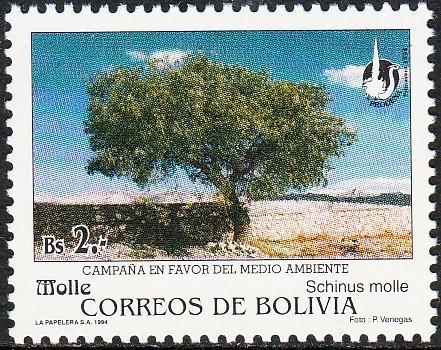
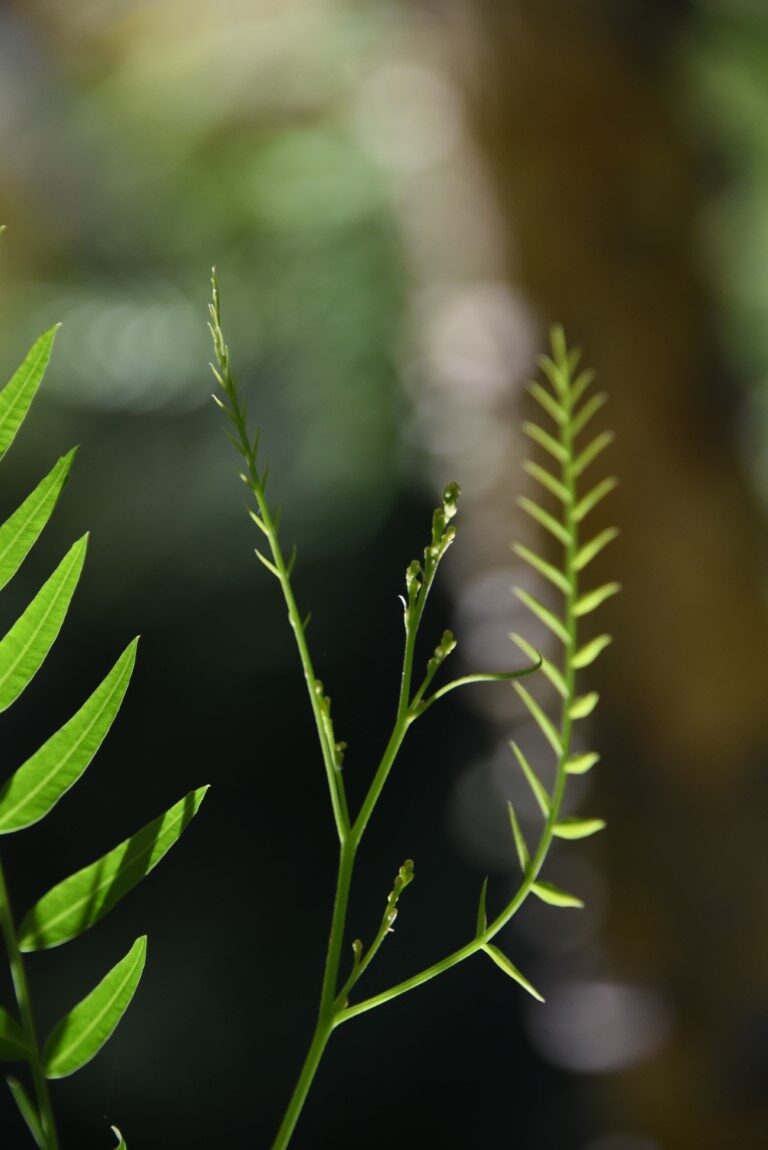
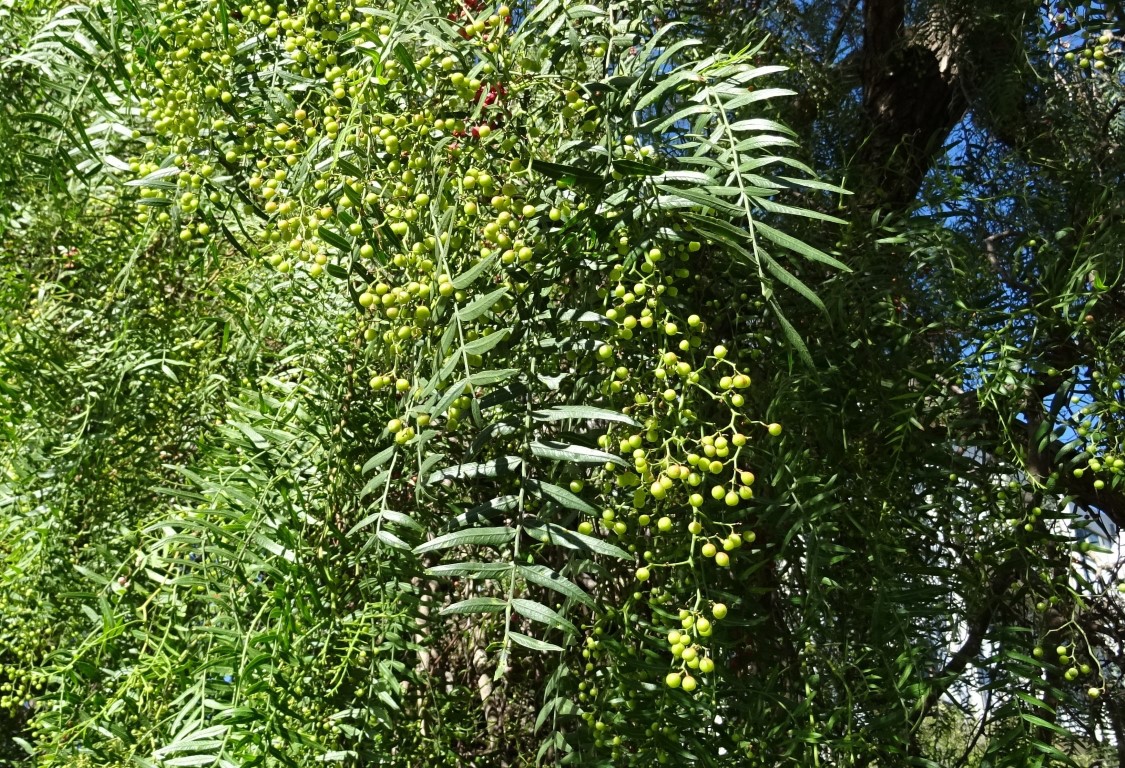
An evergreen, fast-growing tree, typically reaching 6–8 m in height with a broad, pendulous crown. Under favorable conditions it can exceed 15 m. Its trunk is short, cylindrical, 25–35 cm in diameter, with dark brown, rough bark featuring pronounced fissures, which peels and exudes sticky white latex when injured. The leaves are compound, alternate, pinnate, 8–25 cm long, consisting of 20 to 40 leaflets. The leaflets are linear to lanceolate, 2–5 cm long and 4–8 mm wide, with an entire or serrated margin and a vivid green color.
(flowering period, flowers, seeds)
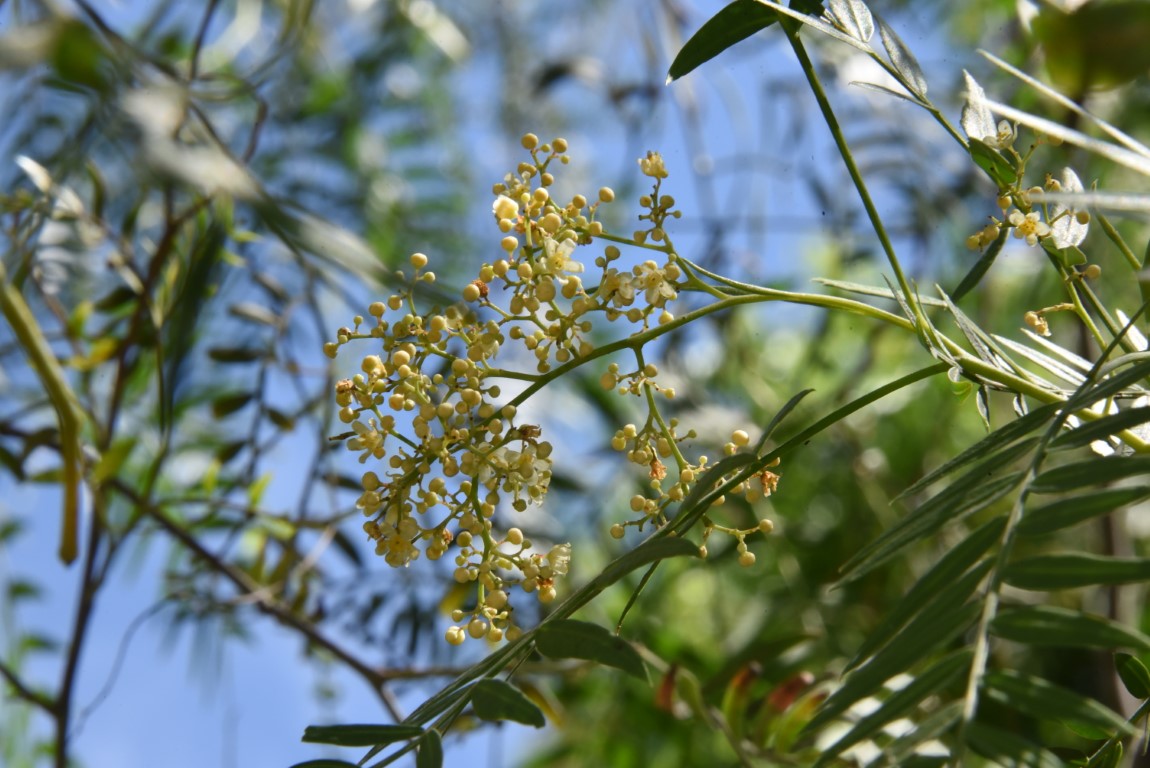
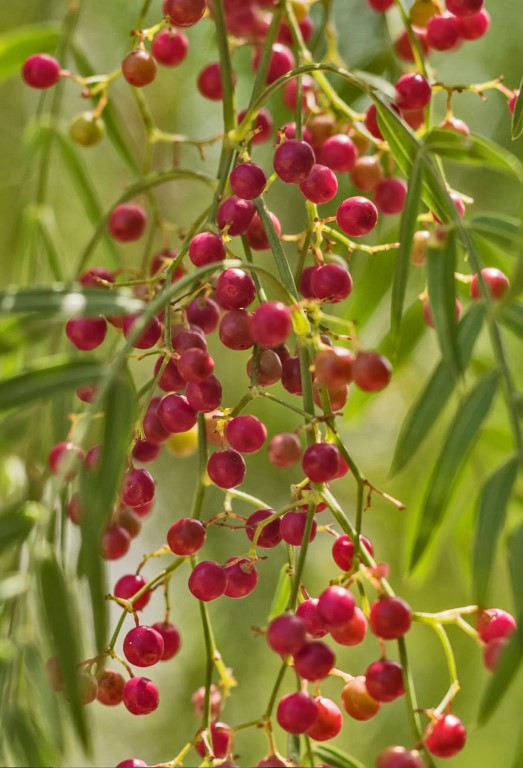
It is a dioecious species, with male and female flowers appearing on separate individuals. The flowers are small, white to pale yellow, and appear in numerous pendulous inflorescences up to 30 cm long at the tips of the branches. The fruits are small, spherical drupes, 5–7 mm in diameter, which develop in dense clusters of hundreds of fruits and change color from green to red, pink, or purplish, and eventually to black as they mature. The seeds are woody, with a hard coat, and their germination is greatly facilitated when they pass through the digestive system of birds or other animals, thereby aiding in their dispersal. The species reproduces both by seed and vegetatively through suckers and cuttings, while seedlings primarily appear in spring, often in large numbers beneath the canopy of the parent tree.
The species is distinguished by the combination of its pendulous crown and clusters of pink fruits.
Schinus molle already had significant use in the pre-Columbian period, as its leaves were employed ritually in Mesoamerican societies for purification and blessings, as well as for dyeing textiles. During the Wari period (600–1000 CE), archaeological evidence indicates that the fruits of the plant were extensively used in the production of the fermented beverage known as chicha de molle, often in combination with hallucinogenic seeds of other plants. Later, the Incas used the oil from the leaves in the process of mummification, while the fruits were used to prepare beverages, syrups, or nutritious maize-based foods. The juice of the leaves was applied to treat eye ailments, while the bark and plant sap were used for swelling, pain, and wounds. The Incas regarded Schinus molle as a sacred tree, dedicated to deities, and planted it near dwellings and public spaces for religious and ceremonial purposes, beyond its medicinal and nutritional value. The dispersal of its seeds by birds contributed to the plant’s wide distribution across various regions of the Andes. The spread of the species beyond its native range occurred during the colonial period, with introductions to Mexico, the United States, and southern Europe, where it has been cultivated mainly as an ornamental or for domestic use. During the colonial era, the durable wood of the species became a valuable material for the manufacture of saddles in the Spanish colonies. Finally, in the late 19th century, the tree was introduced largely to California, where it became known as the “California pepper tree” and acquired a symbolic association with Spanish missions, establishing it as a characteristic ornamental species.
The leaves, bark, and fruits are aromatic and are used in the preparation of foods and beverages. Traditionally, the fruits are used to produce local drinks such as chicha de molle in the Andes and copalocle in Mexico. The fruits are sold as “pink pepper” and used in spices, although the species is not related to common black pepper (Piper nigrum). The wood is hard and used in construction, as firewood, and for charcoal production, while its resin is used as a mastic and the bark in leather processing. In traditional medicine, the fruits contain isoflavonoids and other bioactive compounds with hemostatic, anti-inflammatory, antioxidant, and antimicrobial properties. The leaves, rich in volatile oils, are used to treat eye problems, rheumatism, and inflammation, while the bark juice has laxative, diuretic, and analgesic effects and is applied to pain or swelling in the limbs. Additionally, the species exhibits potential insecticidal properties. Due to its tolerance to semi-arid and alkaline soils, resistance to drought and salty winds, and rapid growth, Schinus molle is widely cultivated as an ornamental tree in parks, avenues, and public spaces, providing shade and decorative value. Furthermore, its use in perfumery and extract production makes it important for industrial purposes as well.
(Note: Ethnobotanical data regarding the medicinal uses of plants must be handled with caution, and their application should be carried out exclusively under medical supervision).
- https://powo.science.kew.org/taxon/urn:lsid:ipni.org:names:71044-1
- https://www.iucnredlist.org/species/61984171/61984173
- https://tropical.theferns.info/viewtropical.php?id=Schinus+molle
- https://apps.worldagroforestry.org/treedb/AFTPDFS/Schinus_molle.PDF
- Bendaoud, H., Romdhane, M., Souchard, J. P., Cazaux, S., & Bouajila, J. (2010). Chemical composition and anticancer and antioxidant activities of Schinus molle L. and Schinus terebinthifolius Raddi berries essential oils. Journal of Food Science, 75(6), C466–C472. https://doi.org/10.1111/j.1750-3841.2010.01711.x
- Cavalcanti, A. S., De Souza Alves, M., Da Silva, L. C. P., Patrocínio, D. S., Sanches, M. N., De Almeida Chaves, D. S., & De Souza, M. A. (2015). Volatiles composition and extraction kinetics from Schinus terebinthifolius and Schinus molle leaves and fruit. Revista Brasileira de Farmacognosia, 25(4), 356–362. https://doi.org/10.1016/j.bjp.2015.07.003
- Díaz, C., Quesada, S., Brenes, O., Aguilar, G., & Cicció, J. F. (2008). Chemical composition of Schinus molle essential oil and its cytotoxic activity on tumour cell lines. Natural Product Research, 22(17), 1521–1534. https://doi.org/10.1080/14786410701848154
- Dikshit, A., Naqvi, A. A., & Husain, A. (1986). Schinus molle: A new source of natural fungitoxicant. Applied and Environmental Microbiology, 51(5), 1085–1088. https://doi.org/10.1128/aem.51.5.1085-1088.1986
- Goldstein, D. J., & Coleman, R. C. (2004). Schinus molle L. (Anacardiaceae) Chicha production in the Central Andes. Economic Botany, 58(4), 523–529. https://doi.org/10.1663/0013-0001(2004)058[0523:SMLACP]2.0.CO;2
- Kramer, F. L. (1957). The pepper tree, Schinus molle L. Economic Botany, 11(4), 322–326. https://doi.org/10.1007/BF02903811
- Martins, M. R., Arantes, S., Candeias, F., Tinoco, M. T., & Cruz-Morais, J. (2014). Antioxidant, antimicrobial and toxicological properties of Schinus molle L. essential oils. Journal of Ethnopharmacology, 151(1), 485–492. https://doi.org/10.1016/j.jep.2013.10.063
References in Αrt
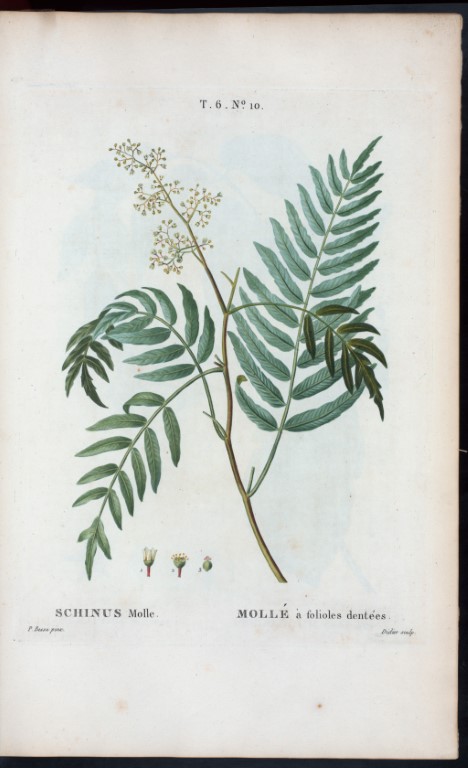
The species is depicted in representations after the 18th century, primarily in woodcuts and botanical illustrations, such as that by Pierre-Joseph Redouté in his work “Traité des arbres et arbustes que l’on cultive en France en pleine terre” (1801–1819).